拥 (yōng) means "to embrace; to crowd" in Chinese. It has 8 strokes with the radical 扌, and is HSK Level 5.
Rated 3.7/5 in difficulty (challenging).
Harder than 36% of HSK Level 5 characters.
Appears in 3+ common words including 拥抱 (yōng bào), 拥挤 (yōng jǐ), 拥有 (yōng yǒu).
Due to its 8 strokes, Hanzi Writer's error detection shows 拥 requires focused practice — most learners need 10+ attempts for consistent accuracy.
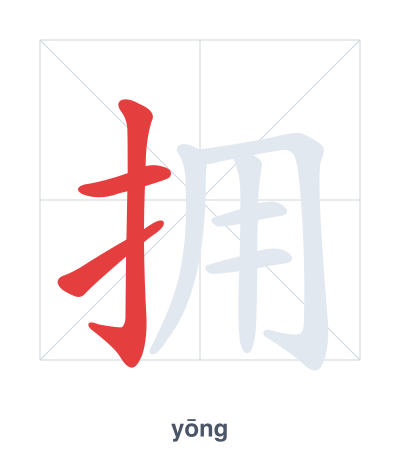
Open Hanzi Writer to see the animated stroke order and practice writing 拥 with real-time feedback.
The character 拥 (yōng) is written with 8 strokes. Follow the standard Chinese stroke order: top to bottom, left to right, outside before inside. The radical 扌 is one of its key components.
Practice the correct stroke order with the Hanzi Writer app to see animated stroke-by-stroke guidance with real-time feedback.
拥 means to embrace; to crowd.
As an HSK Level 5 character, 拥 is an intermediate-level character.
拥 is a phono-semantic compound. The left radical 扌 (hand) indicates an action performed with the hands, while the right side 用 (yòng) provides the pronunciation. Originally it depicted using one's hands to hold or embrace, which extended to meanings like crowding together.
💡 Memory Tip: Picture a hand (扌) using (用) both arms to squeeze into a dense crowd, embracing everyone at once.
他们互相拥抱。
tā men hù xiāng yōng bào
They are hugging each other.
地铁里很拥挤。
dì tiě lǐ hěn yōng jǐ
It is very crowded in the subway.
他拥有一辆车。
tā yōng yǒu yī liàng chē
He owns a car.
Open Hanzi Writer to see the animated stroke order and practice writing 拥 with real-time feedback.
✨ Animated stroke order · Handwriting recognition · HSK-graded practice · Free to use
拥 is made of the radical 扌 (hand) on the left and 用 (to use) on the right. The hand radical suggests a physical action, so 拥 carries the idea of using your hands to hold or crowd around something. This structure gives the character its meanings of 'to embrace' and 'to crowd'.