叶 (yè) means "leaf" in Chinese. It has 5 strokes with the radical 口, and is HSK Level 4.
Rated 2.9/5 in difficulty (moderate).
Harder than 11% of HSK Level 4 characters.
Appears in 3+ common words including 树叶 (shù yè), 茶叶 (chá yè), 叶子 (yè zi).
Hanzi Writer's stroke validation shows learners typically need 5-8 attempts to write 叶 with correct proportion and order.
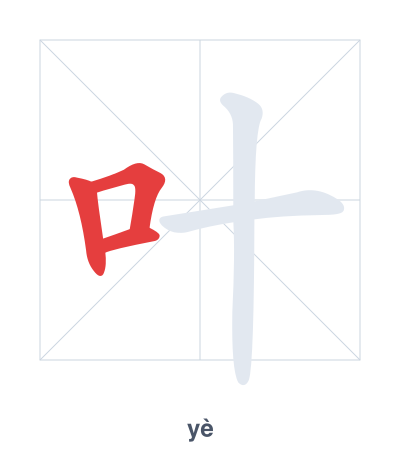
Open Hanzi Writer to see the animated stroke order and practice writing 叶 with real-time feedback.
The character 叶 (yè) is written with 5 strokes. Follow the standard Chinese stroke order: top to bottom, left to right, outside before inside. The radical 口 is one of its key components.
Practice the correct stroke order with the Hanzi Writer app to see animated stroke-by-stroke guidance with real-time feedback.
叶 means leaf.
As an HSK Level 4 character, 叶 is an intermediate-level character.
The character 叶 is a simplified form of the traditional 葉, which originally depicted leaves on a tree. In the modern version, 口 (mouth) resembles the outline of a leaf, while 十 (ten) suggests the central stem or veins running through it.
💡 Memory Tip: Imagine a leaf shaped like an open mouth (口) with a vertical stem (十) splitting it into ten sections.
秋天树叶变黄了。
qiū tiān shù yè biàn huáng le
The leaves turn yellow in autumn.
我想买一点茶叶。
wǒ xiǎng mǎi yì diǎn chá yè
I want to buy some tea.
这片叶子很漂亮。
zhè piàn yè zi hěn piào liàng
This leaf is very beautiful.
Open Hanzi Writer to see the animated stroke order and practice writing 叶 with real-time feedback.
✨ Animated stroke order · Handwriting recognition · HSK-graded practice · Free to use
叶 is composed of the radical 口 (mouth) on the left and 十 (ten) on the right. The 口 suggests a flat, blade-like shape, while 十 represents the veins of a leaf, together forming the image of a leaf.