㐌 (yí) means "Ancient character (variant of 'it' or 'that')" in Chinese. It has 5 strokes with the radical 乙.
Rated 2.7/5 in difficulty (moderate).
Appears in 3+ common words including 㐌字 (yí zì), 写㐌 (xiě yí), 读㐌 (dú yí).
Hanzi Writer's stroke validation shows learners typically need 5-8 attempts to write 㐌 with correct proportion and order.
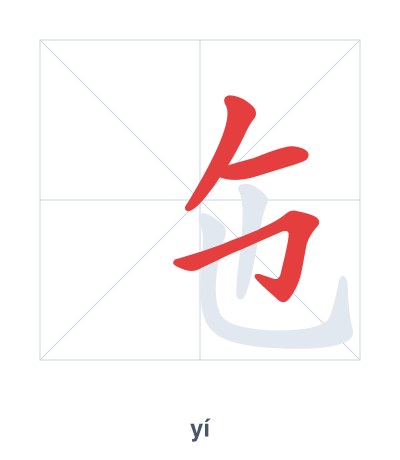
Open Hanzi Writer to see the animated stroke order and practice writing 㐌 with real-time feedback.
The character 㐌 (yí) is written with 5 strokes. Follow the standard Chinese stroke order: top to bottom, left to right, outside before inside. The radical 乙 is one of its key components.
Practice the correct stroke order with the Hanzi Writer app to see animated stroke-by-stroke guidance with real-time feedback.
㐌 means Ancient character (variant of 'it' or 'that').
| Character | 㐌 |
| Pinyin | yí (yi) |
| Meaning | Ancient character (variant of 'it' or 'that') |
| Strokes | 5 |
| Radical | 乙 |
| Difficulty | 2.7/5 |
㐌 is an ancient variant of 它 (tā), meaning 'it' or 'that'. It combines the radical 乙, a hook symbolizing a snake's head or a pointing gesture, with a lower part that originally depicted a coiled snake's body, representing the object being referred to.
💡 Memory Tip: Imagine a hook (乙) snagging a wriggling snake (the lower part) and you point at it, exclaiming 'That's it!'
这个㐌字很难写。
zhè ge yí zì hěn nán xiě 。
This character '㐌' is very hard to write.
他在练习写㐌字。
Tā zài liànxí xiě yí zì.
He is practicing writing the character '㐌'.
老师教我们读㐌。
lǎo shī jiào wǒ men dú yí 。
The teacher taught us how to read the character 'yi'.
Open Hanzi Writer to see the animated stroke order and practice writing 㐌 with real-time feedback.
✨ Animated stroke order · Handwriting recognition · HSK-graded practice · Free to use
㐌 consists of a horizontal stroke at the top, a left-falling stroke in the middle, and the radical 乙 (a hook shape) at the bottom. The radical 乙 suggests a bending or second action, but the character's meaning as an ancient variant of 'it' or 'that' is not directly reflected in its parts; it is a borrowed glyph.