丙 (bǐng) means "Third (in a sequence)" in Chinese. It has 5 strokes with the radical 一, and is HSK Level 7.
Rated 2.7/5 in difficulty (moderate).
Harder than 3% of HSK Level 7 characters.
Appears in 3+ common words including 丙级 (bǐng jí), 丙方 (bǐng fāng), 丙等 (bǐng děng).
Hanzi Writer's stroke validation shows learners typically need 5-8 attempts to write 丙 with correct proportion and order.
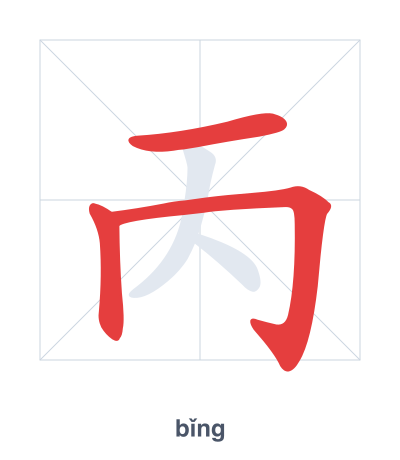
Open Hanzi Writer to see the animated stroke order and practice writing 丙 with real-time feedback.
The character 丙 (bǐng) is written with 5 strokes. Follow the standard Chinese stroke order: top to bottom, left to right, outside before inside. The radical 一 is one of its key components.
Practice the correct stroke order with the Hanzi Writer app to see animated stroke-by-stroke guidance with real-time feedback.
丙 means Third (in a sequence).
As an HSK Level 7 character, 丙 is an intermediate-level character.
C originally depicted a fish's tail in oracle bone script, symbolizing the 'tail end' or 'third' position in the Heavenly Stems sequence. Its modern form combines a horizontal line (一) on top with a modified 'person' (人) shape underneath, though the original pictograph was more curved like a fin.
💡 Memory Tip: Imagine a person (人) ducking under a horizontal bar (一) to become the third in line at a race.
他的考试成绩是丙级。
tā de kǎo shì chéng jì shì bǐng jí
His exam grade is a C.
协议书的末尾需要丙方代表签字。
xié yì shū de mò wěi xū yào bǐng fāng dài biǎo qiān zì 。
The representative of Party C needs to sign at the end of the agreement.
这件产品的质量是丙等。
zhè jiàn chǎn pǐn de zhì liàng shì bǐng děng
The quality of this product is Grade C.
Open Hanzi Writer to see the animated stroke order and practice writing 丙 with real-time feedback.
✨ Animated stroke order · Handwriting recognition · HSK-graded practice · Free to use
The character 丙 consists of the radical 一 (one) at the top, with a vertical stroke, a horizontal hook, a left-falling stroke, and a dot below. Its meaning 'third' does not come from these components; instead, 丙 is a traditional symbol used as the third of the ten Heavenly Stems in Chinese culture.