丘 (qiū) means "hill; mound" in Chinese. It has 5 strokes with the radical 一, and is HSK Level 7.
Rated 2.7/5 in difficulty (moderate).
Harder than 3% of HSK Level 7 characters.
Appears in 3+ common words including 山丘 (shān qiū), 丘陵 (qiū líng), 孔丘 (kǒng qiū).
Hanzi Writer's stroke validation shows learners typically need 5-8 attempts to write 丘 with correct proportion and order.
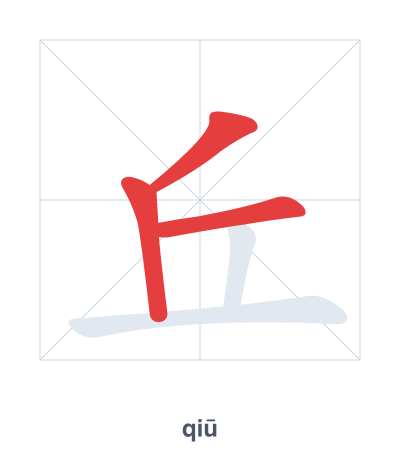
Open Hanzi Writer to see the animated stroke order and practice writing 丘 with real-time feedback.
The character 丘 (qiū) is written with 5 strokes. Follow the standard Chinese stroke order: top to bottom, left to right, outside before inside. The radical 一 is one of its key components.
Practice the correct stroke order with the Hanzi Writer app to see animated stroke-by-stroke guidance with real-time feedback.
丘 means hill; mound.
As an HSK Level 7 character, 丘 is an intermediate-level character.
In oracle bone script, 丘 was a pictograph of two hill peaks rising from the ground. The modern form still suggests a raised landform, with the top stroke (一) representing the hilltop and the lower part (匕) showing the slopes descending on both sides.
💡 Memory Tip: Picture the numeral 7 (like the left side of 丘) resting on a flat line (一) — that's a small hill with a trail going up one side.
前面有一个小山丘。
qián miàn yǒu yí gè xiǎo shān qiū
There is a small hill ahead.
这里的地形主要是丘陵。
zhè lǐ de dì xíng zhǔ yào shì qiū líng
The terrain here consists mainly of hills.
孔丘是孔子的名字。
kǒng qiū shì kǒng zi de míng zì
Kong Qiu is the name of Confucius.
Open Hanzi Writer to see the animated stroke order and practice writing 丘 with real-time feedback.
✨ Animated stroke order · Handwriting recognition · HSK-graded practice · Free to use
The character 丘 is made of 5 strokes: a left-falling stroke, two vertical strokes, and two horizontal strokes. Its shape resembles a side view of a small hill or mound, with a flat top and sloping sides. The radical 一 at the top does not directly indicate meaning, but the overall form visually suggests raised land.