茶 (chá) means "tea" in Chinese. It has 9 strokes with the radical 艹, and is HSK Level 1.
Rated 3.5/5 in difficulty (challenging).
Harder than 82% of HSK Level 1 characters.
Appears in 3+ common words including 喝茶 (hē chá), 绿茶 (lǜ chá), 茶馆 (chá guǎn).
Due to its 9 strokes, Hanzi Writer's error detection shows 茶 requires focused practice — most learners need 10+ attempts for consistent accuracy.
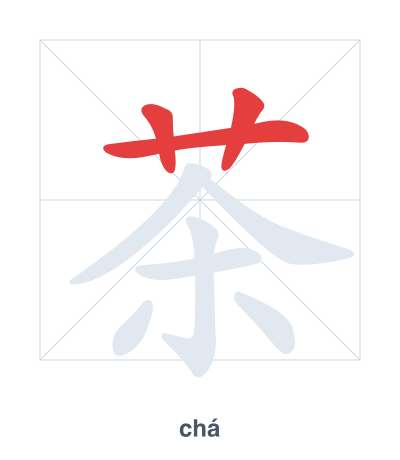
Open Hanzi Writer to see the animated stroke order and practice writing 茶 with real-time feedback.
The character 茶 (chá) is written with 9 strokes. Follow the standard Chinese stroke order: top to bottom, left to right, outside before inside. The radical 艹 is one of its key components.
Practice the correct stroke order with the Hanzi Writer app to see animated stroke-by-stroke guidance with real-time feedback.
茶 means tea.
As an HSK Level 1 character, 茶 is among the first characters beginners learn.
Tea (茶) is a compound character: the radical 艹 (grass) indicates it's a plant, while the lower part 余 combines 人 (person) and 木 (tree), suggesting a person picking leaves from a tea tree. It originally derived from 荼 (tú), a bitter herb, before being specialized for tea.
💡 Memory Tip: Picture a person (人) standing under a tree (木) with grass (艹) on top, plucking leaves to brew tea.
你想喝茶吗?
nǐ xiǎng hē chá ma
Do you want to drink tea?
我每天都喝绿茶。
wǒ měi tiān dōu hē lǜ chá
I drink green tea every day.
我们在茶馆见面吧。
wǒ men zài chá guǎn jiàn miàn ba
Let's meet at the teahouse.
Open Hanzi Writer to see the animated stroke order and practice writing 茶 with real-time feedback.
✨ Animated stroke order · Handwriting recognition · HSK-graded practice · Free to use
茶 is made of the grass radical 艹 on top and the phonetic component 余 (yú) underneath. The grass radical shows that tea comes from a plant, while 余 provides the sound hint. Together, the parts indicate a plant used for making tea.