央 (yāng) means "Center / To beg" in Chinese. It has 5 strokes with the radical 大, and is HSK Level 5.
Rated 2.9/5 in difficulty (moderate).
Harder than 8% of HSK Level 5 characters.
Appears in 3+ common words including 中央 (zhōng yāng), 央求 (yāng qiú), 央视 (yāng shì).
Hanzi Writer's stroke validation shows learners typically need 5-8 attempts to write 央 with correct proportion and order.
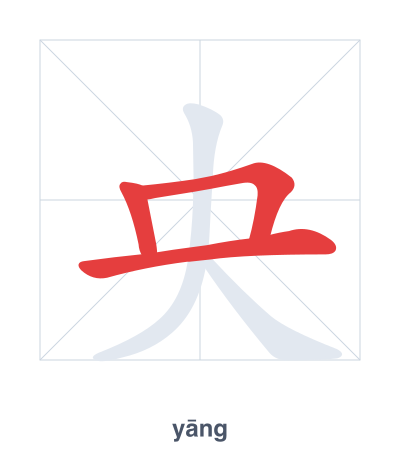
Open Hanzi Writer to see the animated stroke order and practice writing 央 with real-time feedback.
The character 央 (yāng) is written with 5 strokes. Follow the standard Chinese stroke order: top to bottom, left to right, outside before inside. The radical 大 is one of its key components.
Practice the correct stroke order with the Hanzi Writer app to see animated stroke-by-stroke guidance with real-time feedback.
央 means Center / To beg.
As an HSK Level 5 character, 央 is an intermediate-level character.
央 originally depicted a person (大) standing inside an enclosure (冂), symbolizing being in the center or middle. The sense of 'to beg' likely derives from the idea of being cornered in the center and pleading for help.
💡 Memory Tip: Picture a big person (大) trapped inside a box (冂) at the center, begging to get out.
他在中央工作。
tā zài zhōng yāng gōng zuò
He works in the central government.
他央求妈妈买玩具。
tā yāng qiú mā mā mǎi wán jù
He begged his mother to buy a toy.
我看央视新闻。
wǒ kàn yāng shì xīn wén
I watch CCTV News.
Open Hanzi Writer to see the animated stroke order and practice writing 央 with real-time feedback.
✨ Animated stroke order · Handwriting recognition · HSK-graded practice · Free to use
央 is made of 大 (big or person) inside a square enclosure. The enclosure represents a boundary, and the person inside suggests being in the middle, which gives the meaning 'center'.