夭 (yāo) means "To die young / Tender" in Chinese. It has 4 strokes with the radical 大.
Rated 2.7/5 in difficulty (moderate).
Appears in 3+ common words including 夭折 (yāo zhé), 夭夭 (yāo yāo), 夭矫 (yāo jiǎo).
Hanzi Writer's stroke validation shows learners typically need 5-8 attempts to write 夭 with correct proportion and order.
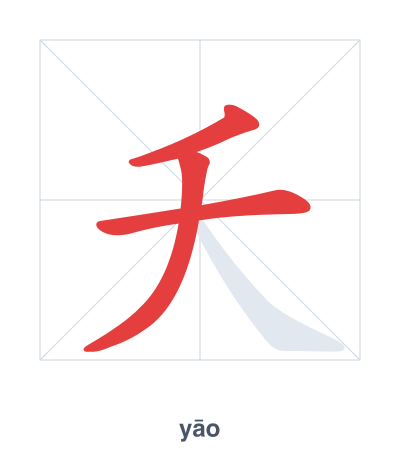
Open Hanzi Writer to see the animated stroke order and practice writing 夭 with real-time feedback.
The character 夭 (yāo) is written with 4 strokes. Follow the standard Chinese stroke order: top to bottom, left to right, outside before inside. The radical 大 is one of its key components.
Practice the correct stroke order with the Hanzi Writer app to see animated stroke-by-stroke guidance with real-time feedback.
夭 means To die young / Tender.
夭 is a pictograph of a person with a tilted head and swinging arms, originally depicting a young person dancing or in motion. This bending or twisting conveys the sense of something delicate or cut short, leading to the meanings 'tender' and 'to die young.' The top stroke represents the bent head, while the two arms splay outward, suggesting incomplete or premature development.
💡 Memory Tip: Imagine a young sprout (the top stroke) bending over and wilting too soon (the two arms drooping), symbolizing a tender life that died young.
计划夭折了。
jì huà yāo zhé le
The plan fell through.
桃花夭夭。
táo huā yāo yāo
The peach blossoms are brilliant and bright.
龙蛇夭矫。
lóng shé yāo jiǎo
Vigorous and graceful (often describing calligraphy or movement).
Open Hanzi Writer to see the animated stroke order and practice writing 夭 with real-time feedback.
✨ Animated stroke order · Handwriting recognition · HSK-graded practice · Free to use
夭 is composed of the radical 大 (big) with a bent or slanted top stroke. The shape suggests a large person bowing or falling, which connects to its meanings of dying young or being tender and delicate.