夯 (hāng) means "To ram / To tamp / Heavy" in Chinese. It has 5 strokes with the radical 大.
Rated 2.9/5 in difficulty (moderate).
Appears in 3+ common words including 夯实 (hāng shí), 夯土 (hāng tǔ), 夯歌 (hāng gē).
Hanzi Writer's stroke validation shows learners typically need 5-8 attempts to write 夯 with correct proportion and order.
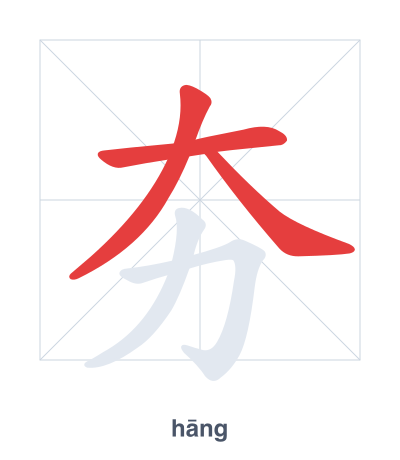
Open Hanzi Writer to see the animated stroke order and practice writing 夯 with real-time feedback.
The character 夯 (hāng) is written with 5 strokes. Follow the standard Chinese stroke order: top to bottom, left to right, outside before inside. The radical 大 is one of its key components.
Practice the correct stroke order with the Hanzi Writer app to see animated stroke-by-stroke guidance with real-time feedback.
夯 means To ram / To tamp / Heavy.
夯 combines 大 (big, heavy) and 力 (strength/effort), depicting a heavy object or great force applied to ram or tamp something down. Its original meaning refers to using a heavy tool to compact earth or other materials.
💡 Memory Tip: Imagine a big (大) muscular worker putting all their strength (力) into slamming a heavy rammer into the ground.
夯实基础很重要。
hāng shí jī chǔ hěn zhòng yào
Consolidating the foundation is very important.
这是夯土墙。
zhè shì hāng tǔ qiáng
This is a rammed earth wall.
工人们唱着夯歌。
gōng rén men chàng zhe hāng gē
The workers are singing a tamping song.
Open Hanzi Writer to see the animated stroke order and practice writing 夯 with real-time feedback.
✨ Animated stroke order · Handwriting recognition · HSK-graded practice · Free to use
夯 is formed by combining the radical 大 (big) on top and 力 (strength) below. Together, they suggest using "big strength" to ram or tamp something down, like earth. This directly reflects the character's meaning of ramming, tamping, or heavy work.