大 (dà/dài) means "Big / large" in Chinese. It has 3 strokes with the radical 大, and is HSK Level 1.
Rated 1.7/5 in difficulty (beginner-friendly).
Harder than 8% of HSK Level 1 characters.
Appears in 4+ common words including 大家 (dà jiā), 大小 (dà xiǎo), 大夫 (dà fū).
In the Hanzi Writer app, most learners master 大 within 3 practice attempts using stroke-by-stroke animation.
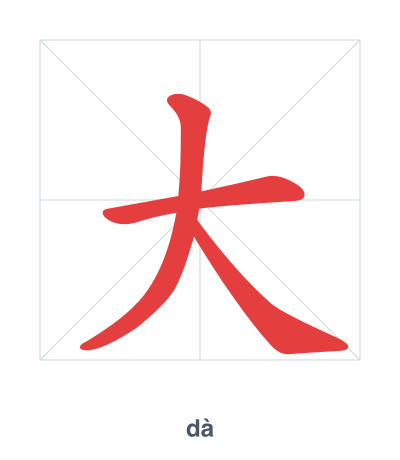
Open Hanzi Writer to see the animated stroke order and practice writing 大 with real-time feedback.
The character 大 (dà/dài) is written with 3 strokes. Follow the standard Chinese stroke order: top to bottom, left to right, outside before inside. The radical 大 is one of its key components.
Practice the correct stroke order with the Hanzi Writer app to see animated stroke-by-stroke guidance with real-time feedback.
大 means Big / large.
This is a polyphonic character with readings: dà, dài.
As an HSK Level 1 character, 大 is among the first characters beginners learn.
大 is a pictograph of a person standing with arms and legs spread wide, originally depicting a 'big' or 'large' human figure. The ancient oracle bone script shows a frontal view of a person with outstretched arms, conveying the concept of size and expansiveness.
💡 Memory Tip: Imagine a person (大) spreading their arms wide to show just how big the thing they're describing is.
谢谢大家一直以来对我的支持。
xiè xiè dà jiā yì zhí yǐ lái duì wǒ de zhī chí
Thank you all for your continuous support.
这双鞋的大小正合适。
zhè shuāng xié de dà xiǎo zhèng hé shì
The size of these shoes is just right.
他生病了,需要去医院看大夫。
tā shēng bìng le xū yào qù yī yuàn kàn dà fū
He is sick and needs to go to the hospital to see a doctor.
他为人很大方。
tā wéi rén hěn dà fāng 。
He is a very generous person.
Open Hanzi Writer to see the animated stroke order and practice writing 大 with real-time feedback.
✨ Animated stroke order · Handwriting recognition · HSK-graded practice · Free to use
大 is a pictograph of a person standing with arms and legs stretched out wide. This image of spreading out represents the idea of being big or large. The character itself is its own radical, which means it is a basic building block for other characters.