夲 (tāo) means "ancient form of 'to advance' or 'root'" in Chinese. It has 5 strokes with the radical 大.
Rated 2.9/5 in difficulty (moderate).
Appears in 3+ common words including 夲 (tāo), 夲草 (tāo cǎo), 夲者 (tāo zhě).
Hanzi Writer's stroke validation shows learners typically need 5-8 attempts to write 夲 with correct proportion and order.
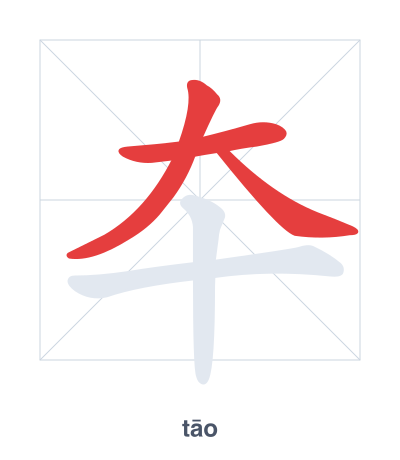
Open Hanzi Writer to see the animated stroke order and practice writing 夲 with real-time feedback.
The character 夲 (tāo) is written with 5 strokes. Follow the standard Chinese stroke order: top to bottom, left to right, outside before inside. The radical 大 is one of its key components.
Practice the correct stroke order with the Hanzi Writer app to see animated stroke-by-stroke guidance with real-time feedback.
夲 means ancient form of 'to advance' or 'root'.
夲 originally depicted a large person (大) standing on a cross mark (十), representing a foundation or root. The cross symbolizes the ground or a fixed point, from which the person advances. Over time, the character came to mean both 'root' and 'to advance'.
💡 Memory Tip: Imagine a giant (大) rooted on a cross (十) as the starting block, ready to sprint forward.
夲是古体字。
tāo shì gǔ tǐ zì
'夲' is an ancient character form.
夲草纲目是古书。
tāo cǎo gāng mù shì gǔ shū
The Compendium of Materia Medica is an ancient book.
夲者,本也。
tāo zhě běn yě
'夲' means 'root' or 'origin'.
Open Hanzi Writer to see the animated stroke order and practice writing 夲 with real-time feedback.
✨ Animated stroke order · Handwriting recognition · HSK-graded practice · Free to use
夲 is composed of the radical 大 (big) on top and a horizontal line below, which originally represented a root or a base. The radical 大 suggests something large or prominent, while the line indicates a starting point, together pointing to the ancient meaning of 'root' or 'advance'.