虘 (cuó) means "Cruel; fierce (archaic)." in Chinese. It has 11 strokes with the radical 虍.
Rated 4.2/5 in difficulty (advanced).
Appears in 3+ common words including 虘肆 (cuó sì), 虘虘 (cuó cuó), 虘暴 (cuó bào).
Due to its 11 strokes, Hanzi Writer's error detection shows 虘 requires focused practice — most learners need 10+ attempts for consistent accuracy.
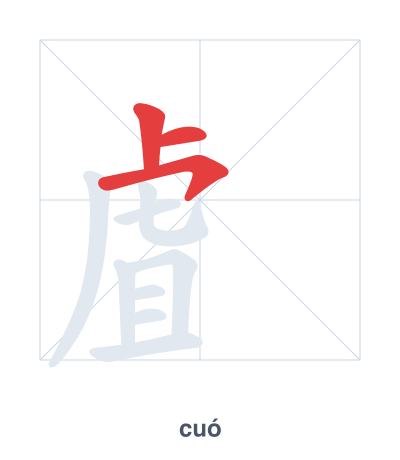
Open Hanzi Writer to see the animated stroke order and practice writing 虘 with real-time feedback.
The character 虘 (cuó) is written with 11 strokes. Follow the standard Chinese stroke order: top to bottom, left to right, outside before inside. The radical 虍 is one of its key components.
Practice the correct stroke order with the Hanzi Writer app to see animated stroke-by-stroke guidance with real-time feedback.
虘 means Cruel; fierce (archaic)..
| Character | 虘 |
| Pinyin | cuó (cuo) |
| Meaning | Cruel; fierce (archaic). |
| Strokes | 11 |
| Radical | 虍 |
| Difficulty | 4.2/5 |
虘 combines the tiger radical 虍, symbolizing a fierce predator, with 且, which may act as a phonetic component or suggest a snarling mouth. Together, they evoke the image of a tiger's cruel, aggressive nature.
💡 Memory Tip: Imagine a fierce tiger (虍) with a square, unyielding jaw (like 且) that shows no mercy.
这个词形容非常放肆。
zhè ge cí xíng róng fēi cháng fàng sì
This word describes being very impudent.
这是古代的一种表达。
zhè shì gǔ dài de yī zhǒng biǎo dá
This is a type of ancient expression.
他的性格有些虘暴。
tā de xìng gé yǒu xiē cuó bào
He has a somewhat violent and cruel personality.
Open Hanzi Writer to see the animated stroke order and practice writing 虘 with real-time feedback.
✨ Animated stroke order · Handwriting recognition · HSK-graded practice · Free to use
The character 虘 is composed of the radical 虍 (tiger) on top and 且 (qiě) below. The tiger radical suggests fierceness or danger, while the lower part may have been used for sound in ancient times. Together, the structure evokes a tiger-like cruelty, matching its archaic meaning of 'fierce' or 'cruel'.