虔 (qián) means "Pious; sincere." in Chinese. It has 10 strokes with the radical 虍, and is HSK Level 7.
Rated 4.2/5 in difficulty (advanced).
Harder than 88% of HSK Level 7 characters.
Appears in 3+ common words including 虔诚 (qián chéng), 虔心 (qián xīn), 虔敬 (qián jìng).
Due to its 10 strokes, Hanzi Writer's error detection shows 虔 requires focused practice — most learners need 10+ attempts for consistent accuracy.
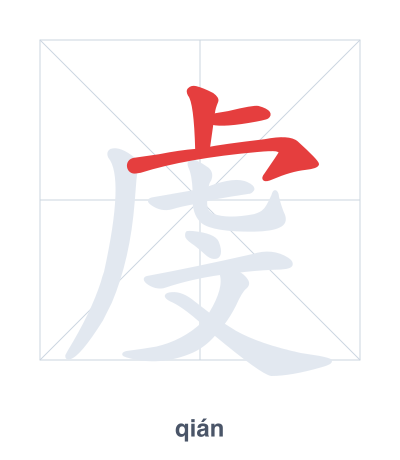
Open Hanzi Writer to see the animated stroke order and practice writing 虔 with real-time feedback.
The character 虔 (qián) is written with 10 strokes. Follow the standard Chinese stroke order: top to bottom, left to right, outside before inside. The radical 虍 is one of its key components.
Practice the correct stroke order with the Hanzi Writer app to see animated stroke-by-stroke guidance with real-time feedback.
虔 means Pious; sincere..
As an HSK Level 7 character, 虔 is an intermediate-level character.
虔 combines the tiger radical (虍), symbolizing awe and power, with 文 (pattern or culture), suggesting refined conduct. The tiger's imposing nature merged with orderly patterns evokes a disciplined and sincere attitude of reverence.
💡 Memory Tip: Imagine a tiger (虍) dressed in a patterned robe (文) kneeling piously in prayer, its head bowed in deep sincerity.
他的态度非常虔诚。
tā de tài dù fēi cháng qián chéng
His attitude is very devout.
他虔心地向佛祈祷。
tā qián xīn dì xiàng fú qí dǎo
He prayed to Buddha devoutly.
学生对老师很虔敬。
xué shēng duì lǎo shī hěn qián jìng
The students are very respectful toward the teacher.
Open Hanzi Writer to see the animated stroke order and practice writing 虔 with real-time feedback.
✨ Animated stroke order · Handwriting recognition · HSK-graded practice · Free to use
The character 虔 consists of the radical 虍 (tiger) on top and the phonetic component 文 (wén, pattern/culture) below. The tiger radical suggests a powerful or imposing force, while 文 adds the idea of refined conduct, together implying a serious, reverent attitude.