弱 (ruò) means "Weak, feeble" in Chinese. It has 10 strokes with the radical 弓, and is HSK Level 4.
Rated 4.2/5 in difficulty (advanced).
Harder than 68% of HSK Level 4 characters.
Appears in 3+ common words including 弱小 (ruò xiǎo), 虚弱 (xū ruò), 弱点 (ruò diǎn).
Due to its 10 strokes, Hanzi Writer's error detection shows 弱 requires focused practice — most learners need 10+ attempts for consistent accuracy.
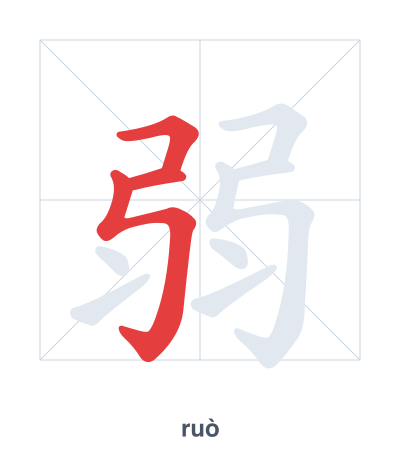
Open Hanzi Writer to see the animated stroke order and practice writing 弱 with real-time feedback.
The character 弱 (ruò) is written with 10 strokes. Follow the standard Chinese stroke order: top to bottom, left to right, outside before inside. The radical 弓 is one of its key components.
Practice the correct stroke order with the Hanzi Writer app to see animated stroke-by-stroke guidance with real-time feedback.
弱 means Weak, feeble.
As an HSK Level 4 character, 弱 is an intermediate-level character.
弱 combines two bows (弓) with three strokes (彡) that originally depicted feathers or hair, symbolizing something soft and easily bent—hence weak or feeble. In ancient Chinese thought, a bow that is not strung tightly or adorned with feathers lacks strength, reinforcing the idea of fragility.
💡 Memory Tip: Imagine two limp bows (弓弓) with three drooping feathers (彡) that are too weak to launch an arrow.
他身体很弱小。
tā shēn tǐ hěn ruò xiǎo
His body is very weak and small.
他的身体很虚弱。
tā de shēn tǐ hěn xū ruò
His body is very weak.
这是他的弱点。
zhè shì tā de ruò diǎn
This is his weakness.
Open Hanzi Writer to see the animated stroke order and practice writing 弱 with real-time feedback.
✨ Animated stroke order · Handwriting recognition · HSK-graded practice · Free to use
The character 弱 is made up of two 弓 (bow) radicals and two small dots (冫, representing ice). Together, they suggest something fragile and easily broken, like an ice-covered bow that is weak and brittle. This directly connects to the character's meaning of 'weak' or 'feeble'.