嫌 (xián) means "To dislike; to complain of; to suspect." in Chinese. It has 13 strokes with the radical 女, and is HSK Level 6.
Rated 4.2/5 in difficulty (advanced).
Harder than 57% of HSK Level 6 characters.
Appears in 3+ common words including 嫌弃 (xián qì), 嫌贵 (xián guì), 嫌麻烦 (xián má fán).
Due to its 13 strokes, Hanzi Writer's error detection shows 嫌 requires focused practice — most learners need 10+ attempts for consistent accuracy.
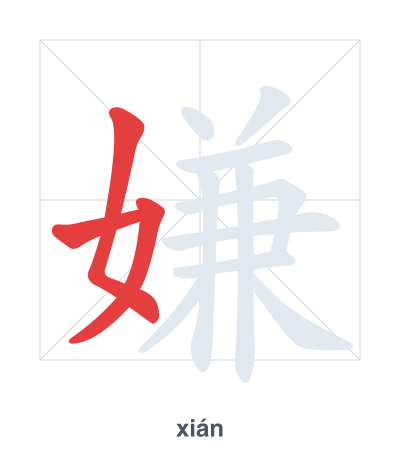
Open Hanzi Writer to see the animated stroke order and practice writing 嫌 with real-time feedback.
The character 嫌 (xián) is written with 13 strokes. Follow the standard Chinese stroke order: top to bottom, left to right, outside before inside. The radical 女 is one of its key components.
Practice the correct stroke order with the Hanzi Writer app to see animated stroke-by-stroke guidance with real-time feedback.
嫌 means To dislike; to complain of; to suspect..
As an HSK Level 6 character, 嫌 is an intermediate-level character.
嫌 is a phono-semantic compound: the left radical 女 (woman) indicates the meaning often relates to women’s feelings, while the right component 兼 (jiān, meaning 'to combine' or 'double') provides the sound and hints at suspicion of duplicity—a woman suspecting double-dealing leads to dislike or complaint.
💡 Memory Tip: A woman (女) sees two (the two '禾' in 兼) of something and immediately dislikes it, suspecting a trick.
他嫌弃这个菜不好吃。
tā xián qì zhè ge cài bù hǎo chī
He complained that the dish didn't taste good.
他嫌贵,没买。
tā xián guì , méi mǎi 。
He thought it was too expensive and didn't buy it.
他嫌麻烦不想去开会。
tā xián má fán bù xiǎng qù kāi huì
He didn't want to go to the meeting because he found it troublesome.
Open Hanzi Writer to see the animated stroke order and practice writing 嫌 with real-time feedback.
✨ Animated stroke order · Handwriting recognition · HSK-graded practice · Free to use
嫌 combines the radical 女 (woman) on the left with 兼 (jiān, meaning double or simultaneous) on the right. This suggests a woman expressing displeasure or suspicion, reflecting the meanings of dislike, complaint, and suspect.