弃 (qì) means "to abandon; to discard" in Chinese. It has 7 strokes with the radical 廾, and is HSK Level 5.
Rated 3.5/5 in difficulty (challenging).
Harder than 23% of HSK Level 5 characters.
Appears in 3+ common words including 放弃 (fàng qì), 丢弃 (diū qì), 弃权 (qì quán).
Due to its 7 strokes, Hanzi Writer's error detection shows 弃 requires focused practice — most learners need 10+ attempts for consistent accuracy.
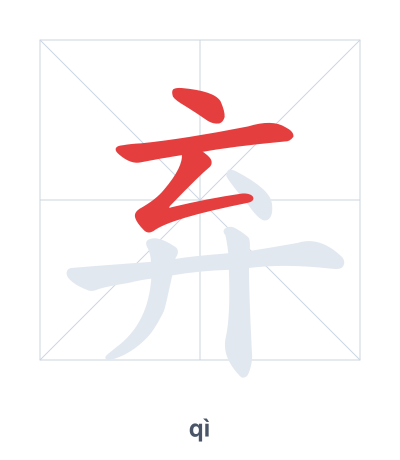
Open Hanzi Writer to see the animated stroke order and practice writing 弃 with real-time feedback.
The character 弃 (qì) is written with 7 strokes. Follow the standard Chinese stroke order: top to bottom, left to right, outside before inside. The radical 廾 is one of its key components.
Practice the correct stroke order with the Hanzi Writer app to see animated stroke-by-stroke guidance with real-time feedback.
弃 means to abandon; to discard.
As an HSK Level 5 character, 弃 is an intermediate-level character.
Ancient scripts of 弃 show a child (子) upside down in a basket, with hands (廾) pushing it away, symbolizing abandonment. The modern form combines 子 (child) and 廾 (two hands), representing the act of discarding something or someone.
💡 Memory Tip: Picture two hands (廾) tossing a child (子) into a dumpster — that's abandoning them.
别轻易放弃。
bié qīng yì fàng qì
Don't give up easily.
垃圾不要乱丢弃。
lā jī bú yào luàn diū qì
Don't litter.
他决定弃权。
tā jué dìng qì quán
He decided to abstain from voting.
Open Hanzi Writer to see the animated stroke order and practice writing 弃 with real-time feedback.
✨ Animated stroke order · Handwriting recognition · HSK-graded practice · Free to use
弃 is made of three components: the top 亠 (lid), the middle 厶 (private), and the bottom 廾 (two hands). The radical 廾 suggests hands, and together the image of hands throwing away a private item under a lid conveys the idea of abandoning or discarding something.