娼 (chāng) means "prostitute" in Chinese. It has 11 strokes with the radical 女.
Rated 4.2/5 in difficulty (advanced).
Appears in 3+ common words including 娼妓 (chāng jì), 娼妇 (chāng fù), 宿娼 (sù chāng).
Due to its 11 strokes, Hanzi Writer's error detection shows 娼 requires focused practice — most learners need 10+ attempts for consistent accuracy.
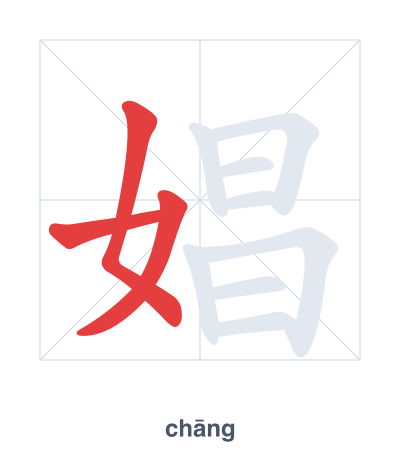
Open Hanzi Writer to see the animated stroke order and practice writing 娼 with real-time feedback.
The character 娼 (chāng) is written with 11 strokes. Follow the standard Chinese stroke order: top to bottom, left to right, outside before inside. The radical 女 is one of its key components.
Practice the correct stroke order with the Hanzi Writer app to see animated stroke-by-stroke guidance with real-time feedback.
娼 means prostitute.
娼 is a phono-semantic compound: the radical 女 (woman) suggests the meaning relates to women, while the component 昌 (chāng, meaning 'prosperous' or 'bright') provides the pronunciation. Historically, 昌 also evoked ideas of singing or entertainment, linking to courtesans who sang and performed.
💡 Memory Tip: Imagine a woman (女) standing under two blazing suns (昌), offering her services for a bright, prosperous price.
这种行为不合法。
zhè zhǒng xíng wéi bù hé fǎ
This behavior is illegal.
这是一个贬义词。
zhè shì yí gè biǎn yì cí
This is a derogatory term.
法律严禁宿娼。
fǎ lǜ yán jìn sù chāng
The law strictly prohibits visiting prostitutes.
Open Hanzi Writer to see the animated stroke order and practice writing 娼 with real-time feedback.
✨ Animated stroke order · Handwriting recognition · HSK-graded practice · Free to use
The character 娼 combines the radical 女 (woman) on the left, indicating the meaning relates to women. On the right is 昌 (chāng, meaning 'prosperous' or 'bright'), which gives the sound and also hints at a negative association with excessive display or public women in old contexts.