唾 (tuò) means "saliva / to spit" in Chinese. It has 11 strokes with the radical 口, and is HSK Level 7.
Rated 4.2/5 in difficulty (advanced).
Harder than 48% of HSK Level 7 characters.
Appears in 3+ common words including 唾液 (tuò yè), 唾弃 (tuò qì), 唾沫 (tuò mò).
Due to its 11 strokes, Hanzi Writer's error detection shows 唾 requires focused practice — most learners need 10+ attempts for consistent accuracy.
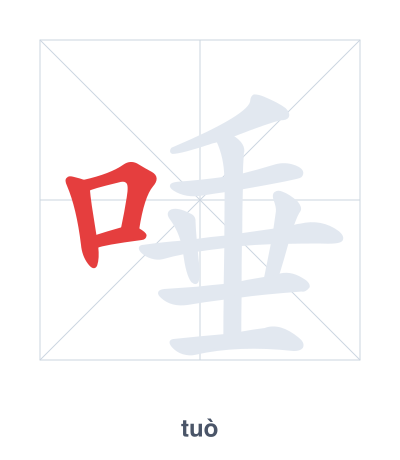
Open Hanzi Writer to see the animated stroke order and practice writing 唾 with real-time feedback.
The character 唾 (tuò) is written with 11 strokes. Follow the standard Chinese stroke order: top to bottom, left to right, outside before inside. The radical 口 is one of its key components.
Practice the correct stroke order with the Hanzi Writer app to see animated stroke-by-stroke guidance with real-time feedback.
唾 means saliva / to spit.
As an HSK Level 7 character, 唾 is an intermediate-level character.
This compound character combines the mouth radical (口) with 垂 (chuí, 'to hang down'). The image is of liquid hanging or dripping from the mouth, vividly representing saliva or the act of spitting.
💡 Memory Tip: Picture someone opening their mouth (口) to spit, with the saliva drooping down like a heavy, dangling thread (垂).
唾液有助于消化。
tuò yè yǒu zhù yú xiāo huà
Saliva helps with digestion.
大家都唾弃谎言。
dà jiā dōu tuò qì huǎng yán
Everyone despises lies.
别乱吐唾沫。
bié luàn tǔ tuò mò
Don't spit everywhere.
Open Hanzi Writer to see the animated stroke order and practice writing 唾 with real-time feedback.
✨ Animated stroke order · Handwriting recognition · HSK-graded practice · Free to use
The character 唾 is made of two parts: the radical 口 (mouth) on the left, and 垂 (chuí, meaning "to hang down") on the right. The mouth radical indicates an action involving the mouth, while 垂 suggests something drooping or falling, so together they mean "saliva" that hangs from the mouth or the act of spitting.