胆 (dǎn) means "Gallbladder / Courage" in Chinese. It has 9 strokes with the radical ⺼, and is HSK Level 5.
Rated 4/5 in difficulty (challenging).
Harder than 57% of HSK Level 5 characters.
Appears in 3+ common words including 胆子 (dǎn zi), 胆小 (dǎn xiǎo), 大胆 (dà dǎn).
Due to its 9 strokes, Hanzi Writer's error detection shows 胆 requires focused practice — most learners need 10+ attempts for consistent accuracy.
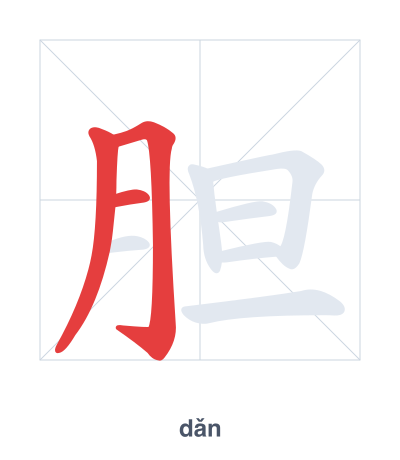
Open Hanzi Writer to see the animated stroke order and practice writing 胆 with real-time feedback.
The character 胆 (dǎn) is written with 9 strokes. Follow the standard Chinese stroke order: top to bottom, left to right, outside before inside. The radical ⺼ is one of its key components.
Practice the correct stroke order with the Hanzi Writer app to see animated stroke-by-stroke guidance with real-time feedback.
胆 means Gallbladder / Courage.
As an HSK Level 5 character, 胆 is an intermediate-level character.
胆 combines the flesh radical ⺼ (indicating a body part) with 旦 (dàn, 'dawn') which provides the sound. In traditional Chinese medicine, the gallbladder was considered the seat of courage, so the character also means 'bravery'.
💡 Memory Tip: Picture your gallbladder glowing like the rising sun (旦) inside your flesh (⺼), filling you with courage to face the day.
他的胆子很大。
tā de dǎn zi hěn dà
He is very brave.
那个孩子很胆小。
nà ge hái zi hěn dǎn xiǎo
That child is very timid.
这是一个大胆的想法。
zhè shì yí gè dà dǎn de xiǎng fǎ
This is a bold idea.
Open Hanzi Writer to see the animated stroke order and practice writing 胆 with real-time feedback.
✨ Animated stroke order · Handwriting recognition · HSK-graded practice · Free to use
胆 is made of two parts: the left radical ⺼ (flesh/body) and the right part 旦 (dàn, meaning dawn). The radical shows that 胆 refers to a body organ (the gallbladder), while 旦 gives a clue to the pronunciation. The extended meaning "courage" comes from the gallbladder's cultural association with bravery in Chinese medicine.