鞋 (xié) means "Shoes" in Chinese. It has 15 strokes with the radical 革, and is HSK Level 2.
Rated 3.7/5 in difficulty (challenging).
Harder than 98% of HSK Level 2 characters.
Appears in 3+ common words including 运动鞋 (yùn dòng xié), 皮鞋 (pí xié), 穿鞋 (chuān xié).
Due to its 15 strokes, Hanzi Writer's error detection shows 鞋 requires focused practice — most learners need 10+ attempts for consistent accuracy.
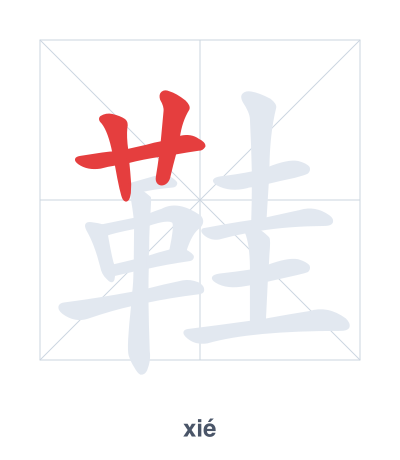
Open Hanzi Writer to see the animated stroke order and practice writing 鞋 with real-time feedback.
The character 鞋 (xié) is written with 15 strokes. Follow the standard Chinese stroke order: top to bottom, left to right, outside before inside. The radical 革 is one of its key components.
Practice the correct stroke order with the Hanzi Writer app to see animated stroke-by-stroke guidance with real-time feedback.
鞋 means Shoes.
As an HSK Level 2 character, 鞋 is among the first characters beginners learn.
鞋 is a semantic-phonetic compound. The left side 革 (leather/hide) indicates the material used for ancient shoes, while the right side 圭 (guì, jade tablet) originally served as a phonetic hint (though the modern pronunciation shifted to xié). Together, the character shows that shoes were traditionally made from leather.
💡 Memory Tip: Picture someone wrapping their feet in leather (革) and then standing on two stacked blocks of earth (圭) to protect their soles—those are your shoes.
我想买一双运动鞋。
wǒ xiǎng mǎi yī shuāng yùn dòng xié
I want to buy a pair of sneakers.
这双皮鞋很漂亮。
zhè shuāng pí xié hěn piào liàng
This pair of leather shoes is very beautiful.
出门前请一定要穿鞋,别光着脚在地上跑。
chū mén qián qǐng yí dìng yào chuān xié , bié guāng zhe jiǎo zài dì shàng pǎo 。
Please make sure to wear shoes before going out; don't run on the ground barefoot.
Open Hanzi Writer to see the animated stroke order and practice writing 鞋 with real-time feedback.
✨ Animated stroke order · Handwriting recognition · HSK-graded practice · Free to use
The character 鞋 consists of the radical 革 on the left, which means 'leather' or 'hide', and 圭 on the right, which provides the sound. Since many traditional shoes were made of leather, the radical directly connects to the meaning 'shoes'.