退 (tuì) means "to retreat; to withdraw; to return" in Chinese. It has 9 strokes with the radical 辶, and is HSK Level 3.
Rated 4/5 in difficulty (challenging).
Harder than 70% of HSK Level 3 characters.
Appears in 3+ common words including 后退 (hòu tuì), 退休 (tuì xiū), 退步 (tuì bù).
Due to its 9 strokes, Hanzi Writer's error detection shows 退 requires focused practice — most learners need 10+ attempts for consistent accuracy.
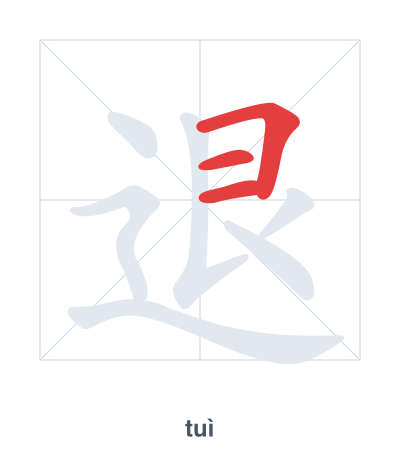
Open Hanzi Writer to see the animated stroke order and practice writing 退 with real-time feedback.
The character 退 (tuì) is written with 9 strokes. Follow the standard Chinese stroke order: top to bottom, left to right, outside before inside. The radical 辶 is one of its key components.
Practice the correct stroke order with the Hanzi Writer app to see animated stroke-by-stroke guidance with real-time feedback.
退 means to retreat; to withdraw; to return.
As an HSK Level 3 character, 退 is an intermediate-level character.
退 combines the radical 辶 (walk, movement) with 艮 (gèn, originally depicting a person turning their head backward). Together, they suggest the action of walking while looking back, thus moving in reverse or withdrawing.
💡 Memory Tip: Picture a person (艮) stepping backward on a path (辶) to retreat from a confrontation.
汽车正在缓慢后退。
qì chē zhèng zài huǎn màn hòu tuì
The car is slowly reversing.
他的爸爸快要退休了。
tā de bà bà kuài yào tuì xiū le
His father is about to retire.
他的汉语退步了很多。
tā de hàn yǔ tuì bù le hěn duō
His Chinese has regressed a lot.
Open Hanzi Writer to see the animated stroke order and practice writing 退 with real-time feedback.
✨ Animated stroke order · Handwriting recognition · HSK-graded practice · Free to use
退 is composed of the radical 辶 (walk) on the left and 艮 (gèn) on the right. The radical suggests movement, and the component 艮 originally meant "stop" or "root," together implying stepping back or retreating.