休 (xiū) means "To rest; to stop; to divorce" in Chinese. It has 6 strokes with the radical 亻, and is HSK Level 1.
Rated 2.4/5 in difficulty (moderate).
Harder than 27% of HSK Level 1 characters.
Appears in 3+ common words including 休息 (xiū xī), 休假 (xiū jià), 退休 (tuì xiū).
Hanzi Writer's stroke validation shows learners typically need 5-8 attempts to write 休 with correct proportion and order.
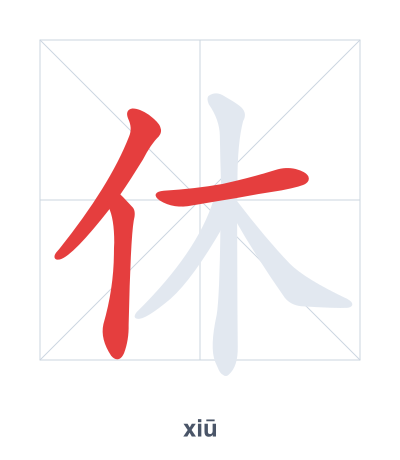
Open Hanzi Writer to see the animated stroke order and practice writing 休 with real-time feedback.
The character 休 (xiū) is written with 6 strokes. Follow the standard Chinese stroke order: top to bottom, left to right, outside before inside. The radical 亻 is one of its key components.
Practice the correct stroke order with the Hanzi Writer app to see animated stroke-by-stroke guidance with real-time feedback.
休 means To rest; to stop; to divorce.
As an HSK Level 1 character, 休 is among the first characters beginners learn.
休 is a compound character combining the radical 亻 (person) and 木 (tree). The image shows a person leaning against a tree, which vividly conveys the meaning of taking a rest or stopping. In ancient usage, this was also extended to mean divorce, as a spouse might 'rest' from the marriage.
💡 Memory Tip: Picture a tired worker (亻) plopping down against a big tree (木) to finally rest.
我们休息十分钟吧。
wǒ men xiū xī shí fēn zhōng ba
Let's take a ten-minute break.
他下周要休假。
tā xià zhōu yào xiū jià
He is going on vacation next week.
我爷爷去年退休了。
wǒ yé yé qù nián tuì xiū le
My grandfather retired last year.
Open Hanzi Writer to see the animated stroke order and practice writing 休 with real-time feedback.
✨ Animated stroke order · Handwriting recognition · HSK-graded practice · Free to use
休 is made of two parts: the radical 亻 (person) on the left and 木 (tree) on the right. The image of a person leaning against a tree directly suggests the idea of resting. This structural composition is a clear visual metaphor for taking a break.