桃 (táo) means "peach" in Chinese. It has 10 strokes with the radical 木, and is HSK Level 5.
Rated 4.2/5 in difficulty (advanced).
Harder than 75% of HSK Level 5 characters.
Appears in 3+ common words including 桃子 (táo zi), 桃花 (táo huā), 核桃 (hé táo).
Due to its 10 strokes, Hanzi Writer's error detection shows 桃 requires focused practice — most learners need 10+ attempts for consistent accuracy.
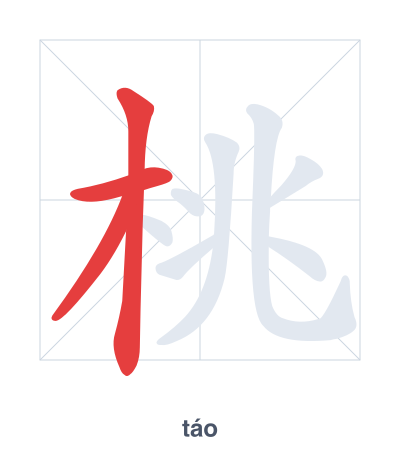
Open Hanzi Writer to see the animated stroke order and practice writing 桃 with real-time feedback.
The character 桃 (táo) is written with 10 strokes. Follow the standard Chinese stroke order: top to bottom, left to right, outside before inside. The radical 木 is one of its key components.
Practice the correct stroke order with the Hanzi Writer app to see animated stroke-by-stroke guidance with real-time feedback.
桃 means peach.
As an HSK Level 5 character, 桃 is an intermediate-level character.
桃 (táo) is a phono-semantic compound. The radical 木 (tree) indicates it relates to a type of tree, and the component 兆 (zhào, meaning 'omen' or 'sign') provides the pronunciation. Together, they represent the peach tree, whose fruit was considered an auspicious symbol of longevity in ancient China.
💡 Memory Tip: Imagine a tree (木) bearing a peach that has the cracks of an omen (兆) on its skin, foretelling a sweet and lucky harvest.
这个桃子又大又甜。
zhè ge táo zi yòu dà yòu tián
This peach is big and sweet.
桃花在春天开放。
táo huā zài chūn tiān kāi fàng
Peach blossoms bloom in spring.
多吃核桃对大脑好。
duō chī hé táo duì dà nǎo hǎo
Eating more walnuts is good for the brain.
Open Hanzi Writer to see the animated stroke order and practice writing 桃 with real-time feedback.
✨ Animated stroke order · Handwriting recognition · HSK-graded practice · Free to use
桃 is composed of the radical 木 (tree or wood) on the left and the phonetic component 兆 on the right. The 木 indicates that a peach grows on a tree, while 兆 provides the pronunciation "tào" and originally meant "sign" or "omen." Together, they create a character that means "peach tree" or "peach."