术 (shù) means "Skill / Technique / Method" in Chinese. It has 5 strokes with the radical 木, and is HSK Level 3.
Rated 2.9/5 in difficulty (moderate).
Harder than 24% of HSK Level 3 characters.
Appears in 3+ common words including 技术 (jì shù), 艺术 (yì shù), 手术 (shǒu shù).
Hanzi Writer's stroke validation shows learners typically need 5-8 attempts to write 术 with correct proportion and order.
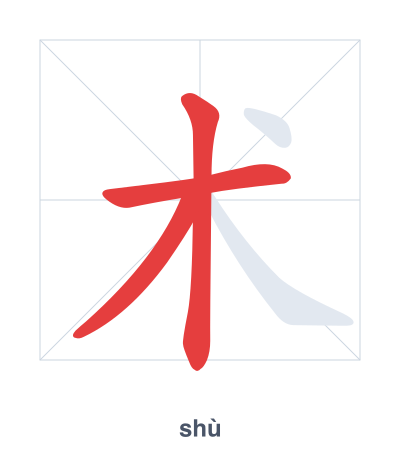
Open Hanzi Writer to see the animated stroke order and practice writing 术 with real-time feedback.
The character 术 (shù) is written with 5 strokes. Follow the standard Chinese stroke order: top to bottom, left to right, outside before inside. The radical 木 is one of its key components.
Practice the correct stroke order with the Hanzi Writer app to see animated stroke-by-stroke guidance with real-time feedback.
术 means Skill / Technique / Method.
As an HSK Level 3 character, 术 is an intermediate-level character.
Originally, 术 was a pictograph of a millet plant with a drooping head, later borrowed to mean 'skill' or 'method'. The modern simplified form shows a tree (木) with a dot, representing a technique applied to woodworking or craftsmanship.
💡 Memory Tip: Picture a tree (木) with a tiny dot (丶) as a secret mark—a special skill carved into its bark.
他的电脑技术很好。
tā de diàn nǎo jì shù hěn hǎo
His computer skills are very good.
她非常喜欢艺术。
tā fēi cháng xǐ huān yì shù
She likes art very much.
医生正在做手术。
yī shēng zhèng zài zuò shǒu shù
The doctor is performing surgery.
Open Hanzi Writer to see the animated stroke order and practice writing 术 with real-time feedback.
✨ Animated stroke order · Handwriting recognition · HSK-graded practice · Free to use
术 consists of the radical 木 (wood/tree) with an extra stroke or dot. The wood radical suggests a connection to craft or materials, while the extra element represents a method or skill applied to working with wood, giving the character the sense of 'technique' or 'art.'