杭 (háng) means "Hangzhou (abbreviation); to cross a river" in Chinese. It has 8 strokes with the radical 木.
Rated 3.7/5 in difficulty (challenging).
Appears in 3+ common words including 杭州 (háng zhōu), 杭帮菜 (háng bāng cài), 苏杭 (sū háng).
Due to its 8 strokes, Hanzi Writer's error detection shows 杭 requires focused practice — most learners need 10+ attempts for consistent accuracy.
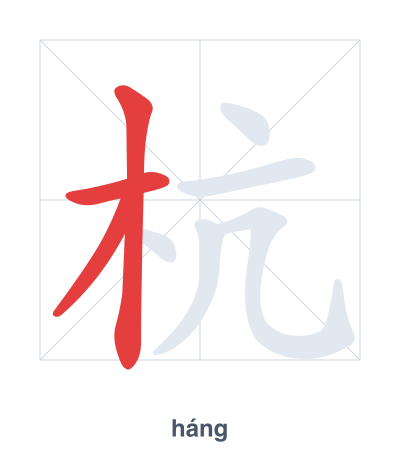
Open Hanzi Writer to see the animated stroke order and practice writing 杭 with real-time feedback.
The character 杭 (háng) is written with 8 strokes. Follow the standard Chinese stroke order: top to bottom, left to right, outside before inside. The radical 木 is one of its key components.
Practice the correct stroke order with the Hanzi Writer app to see animated stroke-by-stroke guidance with real-time feedback.
杭 means Hangzhou (abbreviation); to cross a river.
杭 combines the radical 木 (wood/tree) with 亢 (kàng, meaning 'high' or 'neck'). Originally, it referred to a wooden boat or raft used to cross a river, symbolizing a way to traverse water. Later it became the abbreviation for Hangzhou, a city known for its waterways and bridges.
💡 Memory Tip: Picture a wooden boat (木) with a tall neck (亢) steering it across a river to reach the famous city of Hangzhou.
我去年去了杭州。
wǒ qù nián qù le háng zhōu
I went to Hangzhou last year.
杭帮菜很好吃。
háng bāng cài hěn hǎo chī
Hangzhou cuisine is delicious.
苏杭的风景很美。
sū háng de fēng jǐng hěn měi
The scenery in Suzhou and Hangzhou is very beautiful.
Open Hanzi Writer to see the animated stroke order and practice writing 杭 with real-time feedback.
✨ Animated stroke order · Handwriting recognition · HSK-graded practice · Free to use
杭 is made of the wood radical 木 on the left and the character 亢 (kàng, meaning "high" or "to cross") on the right. The wood radical suggests a wooden structure like a bridge, while 亢 gives the sound háng and adds the idea of crossing, together forming the meaning "to cross a river." This also connects to Hangzhou, a city known for its waterways and bridges.