杪 (miǎo) means "tip of a branch; end of a period" in Chinese. It has 8 strokes with the radical 木.
Rated 3.7/5 in difficulty (challenging).
Appears in 3+ common words including 树杪 (shù miǎo), 岁杪 (suì miǎo), 月杪 (yuè miǎo).
Due to its 8 strokes, Hanzi Writer's error detection shows 杪 requires focused practice — most learners need 10+ attempts for consistent accuracy.
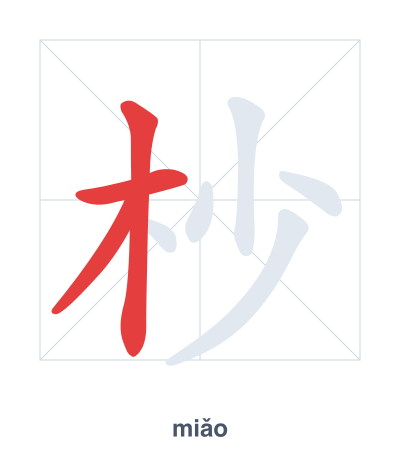
Open Hanzi Writer to see the animated stroke order and practice writing 杪 with real-time feedback.
The character 杪 (miǎo) is written with 8 strokes. Follow the standard Chinese stroke order: top to bottom, left to right, outside before inside. The radical 木 is one of its key components.
Practice the correct stroke order with the Hanzi Writer app to see animated stroke-by-stroke guidance with real-time feedback.
杪 means tip of a branch; end of a period.
杪 combines the radical 木 (tree) with 少 (small), indicating the small, outermost part of a tree — the branch tip. This extends to mean the end of any period, like the tip of a season or year.
💡 Memory Tip: Picture a tree (木) whose smallest (少) twig at the very tip is called 杪.
鸟儿落在树杪。
niǎo ér luò zài shù miǎo
The bird landed on the tip of the branch.
岁杪时天气很冷。
suì miǎo shí tiān qì hěn lěng
The weather is very cold at the end of the year.
我们月杪见面吧。
wǒ men yuè miǎo jiàn miàn ba
Let's meet at the end of the month.
Open Hanzi Writer to see the animated stroke order and practice writing 杪 with real-time feedback.
✨ Animated stroke order · Handwriting recognition · HSK-graded practice · Free to use
The character 杪 combines the radical 木 (wood/tree) on the left with 少 (few/little) on the right. The wood radical indicates a part of a tree, and 少 suggests something small or tiny, together pointing to the tip of a branch. This structure also extends to mean the end of a period, like a tiny point in time.