Hanzi Writer

How to Write 着 (zhāo/zháo/zhe/zhuó) — Meaning “To wear; to touch; (particle indicating a state).”

zhāo/zháo/zhe/zhuó HSK Level 1 11 strokes Radical: 目

着 (zhāo/zháo/zhe/zhuó) means "To wear; to touch; (particle indicating a state)." in Chinese. It has 11 strokes with the radical 目, and is HSK Level 1.

Rated 3.7/5 in difficulty (challenging).

Harder than 93% of HSK Level 1 characters.

Appears in 6+ common words including 看着 (kàn zhe), 听着 (tīng zhe), 着数 (zhāo shù).

Due to its 11 strokes, Hanzi Writer's error detection shows 着 requires focused practice — most learners need 10+ attempts for consistent accuracy.
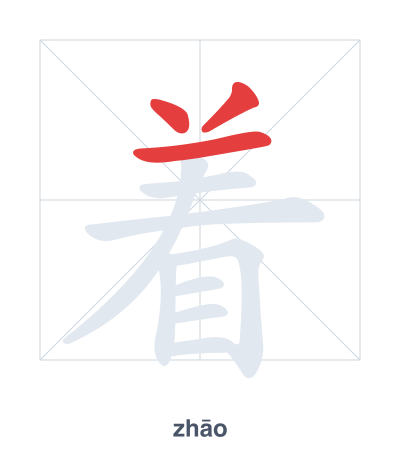
Stroke order practice for 着 - zhāo/zháo/zhe/zhuó

Practice Writing 着 (zhāo/zháo/zhe/zhuó)

Open Hanzi Writer to see the animated stroke order and practice writing 着 with real-time feedback.

The character (zhāo/zháo/zhe/zhuó) is written with 11 strokes. Follow the standard Chinese stroke order: top to bottom, left to right, outside before inside. The radical is one of its key components.

Practice the correct stroke order with the Hanzi Writer app to see animated stroke-by-stroke guidance with real-time feedback.

means To wear; to touch; (particle indicating a state)..

This is a polyphonic character with readings: zhāo, zháo, zhe, zhuó.

As an HSK Level 1 character, is among the first characters beginners learn.

Character
Pinyinzhāo / zháo / zhe / zhuó (zhao/zhe/zhuo)
MeaningTo wear; to touch; (particle indicating a state).
Strokes11
Radical
HSK Level1
Difficulty3.7/5

The character 着 combines a sheep's head (䒑, a variant of 羊) and an eye (目), originally depicting a sheep looking intently at something—this focused attention evolved into meanings like 'to touch' (as in making contact) and 'to wear' (clothing touching the body), while later usage added a grammatical particle indicating a state.

💡 Memory Tip: Picture a sheep (䒑) with a huge eye (目) wearing a tiny hat—the hat is just 'touching' its head.

kàn zhe
looking at; watching
tīng zhe
Listen; listening.
zhāo shù
A move in a game (like chess) or a tactic/trick.
gāo zhāo
A clever move; a brilliant strategy.
zháo jí
Anxious; worried; in a hurry.
zháo huǒ
to catch fire; to be on fire

他静静地看着远方的夕阳。

tā jìng jìng dì kàn zhe yuǎn fāng de xī yáng

He quietly watched the setting sun in the distance.

听着美妙的音乐,他心情格外舒畅。

tīng zhe měi miào de yīn yuè tā xīn qíng gé wài shū chàng

Listening to the beautiful music, he felt exceptionally relaxed and happy.

这一步棋是他的绝妙着数,反败为胜。

zhè yī bù qí shì tā de jué miào zhāo shù fǎn bài wéi shèng

This move was a brilliant tactic of his, turning defeat into victory.

经理这一招确实是高着,解决了难题。

jīng lǐ zhè yī zhāo què shí shì gāo zhāo jiě jué le nán tí

The manager's move was indeed a clever one; it solved the difficult problem.

Character Pinyin Strokes Radical
(current) zhāo / zháo / zhe / zhuó 11
xiāng / xiàng 9
dǔn 9
pàn 9
Stroke order practice for 着 - zhāo/zháo/zhe/zhuó

Practice Writing 着 (zhāo/zháo/zhe/zhuó)

Open Hanzi Writer to see the animated stroke order and practice writing 着 with real-time feedback.

✨ Animated stroke order · Handwriting recognition · HSK-graded practice · Free to use

Frequently Asked Questions about 着

The character 着 combines the radical 目 (eye) on top with a phonetic or structural element underneath. The eye radical relates to seeing or watching, which connects to meanings like 'looking at' (看着) or 'to touch' (as in visual contact). The lower part originally suggested a person wearing a hat, linking to the meaning 'to wear' (e.g., 穿着).

More HSK Level 1 Characters

Characters with Radical 目

Other 11-Stroke Characters