椅 (yǐ) means "Chair" in Chinese. It has 12 strokes with the radical 木, and is HSK Level 2.
Rated 3.7/5 in difficulty (challenging).
Harder than 80% of HSK Level 2 characters.
Appears in 3+ common words including 椅子 (yǐ zi), 沙发椅 (shā fā yǐ), 折叠椅 (zhé dié yǐ).
Due to its 12 strokes, Hanzi Writer's error detection shows 椅 requires focused practice — most learners need 10+ attempts for consistent accuracy.
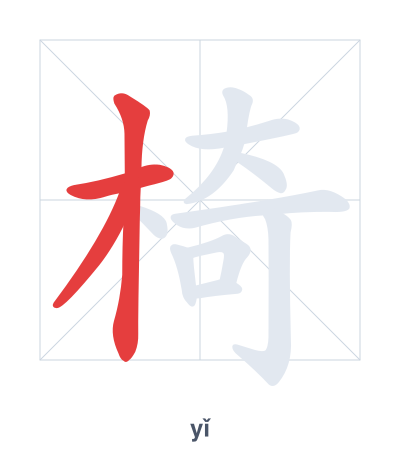
Open Hanzi Writer to see the animated stroke order and practice writing 椅 with real-time feedback.
The character 椅 (yǐ) is written with 12 strokes. Follow the standard Chinese stroke order: top to bottom, left to right, outside before inside. The radical 木 is one of its key components.
Practice the correct stroke order with the Hanzi Writer app to see animated stroke-by-stroke guidance with real-time feedback.
椅 means Chair.
As an HSK Level 2 character, 椅 is among the first characters beginners learn.
椅 is a phono-semantic compound: the radical 木 (wood) indicates the material, and 奇 (qí) provides the pronunciation, originally referring to a type of tree before being borrowed to mean 'chair', a wooden seat.
💡 Memory Tip: Picture a wooden (木) chair with a strange (奇) wobbly leg that makes you sit oddly straight.
请坐在椅子上。
qǐng zuò zài yǐ zi shàng
Please sit on the chair.
这个沙发椅很舒服。
zhè ge shā fā yǐ hěn shū fú
This armchair is very comfortable.
我买了一把折叠椅。
wǒ mǎi le yī bǎ zhé dié yǐ
I bought a folding chair.
Open Hanzi Writer to see the animated stroke order and practice writing 椅 with real-time feedback.
✨ Animated stroke order · Handwriting recognition · HSK-graded practice · Free to use
椅 is made of two parts: the left side is 木 (wood), showing that chairs are often made of wood. The right side is 奇, which gives a hint to the pronunciation (though not exact). Together, they form a phono-semantic compound where 木 points to the meaning and 奇 hints at the sound.