锁 (suǒ) means "Lock / To lock" in Chinese. It has 12 strokes with the radical 钅, and is HSK Level 5.
Rated 4.2/5 in difficulty (advanced).
Harder than 97% of HSK Level 5 characters.
Appears in 3+ common words including 锁门 (suǒ mén), 开锁 (kāi suǒ), 锁头 (suǒ tou).
Due to its 12 strokes, Hanzi Writer's error detection shows 锁 requires focused practice — most learners need 10+ attempts for consistent accuracy.
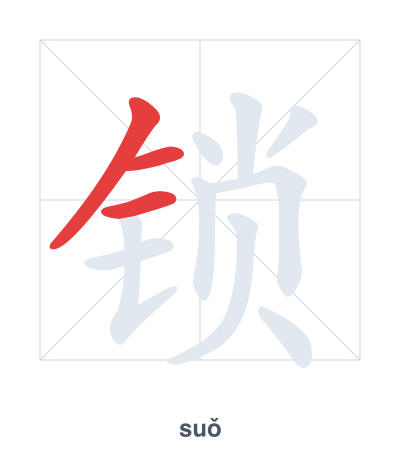
Open Hanzi Writer to see the animated stroke order and practice writing 锁 with real-time feedback.
The character 锁 (suǒ) is written with 12 strokes. Follow the standard Chinese stroke order: top to bottom, left to right, outside before inside. The radical 钅 is one of its key components.
Practice the correct stroke order with the Hanzi Writer app to see animated stroke-by-stroke guidance with real-time feedback.
锁 means Lock / To lock.
As an HSK Level 5 character, 锁 is an intermediate-level character.
锁 combines the radical 钅 (metal, indicating material) with 所 (place, also supplying pronunciation). The character originally depicted a metal device used to secure a door or container, hence 'lock' or 'to lock'.
💡 Memory Tip: Imagine a metal key (钅) turning in a lock at the main entrance (所) of a house to secure it.
出门前请记得锁门。
chū mén qián qǐng jì de suǒ mén
Please remember to lock the door before going out.
他正在用钥匙开锁。
tā zhèng zài yòng yào shi kāi suǒ
He is using a key to unlock the door.
这个锁头已经坏了。
zhè ge suǒ tou yǐ jīng huài le
This padlock is already broken.
Open Hanzi Writer to see the animated stroke order and practice writing 锁 with real-time feedback.
✨ Animated stroke order · Handwriting recognition · HSK-graded practice · Free to use
锁 is made of the radical 钅 (metal) on the left and the component 所 (place) on the right. The metal radical suggests that locks are usually made of metal, while 所 indicates a location or thing, together meaning a metal device that secures a place.