嗜 (shì) means "To be fond of or have an addiction to." in Chinese. It has 13 strokes with the radical 口, and is HSK Level 7.
Rated 4.2/5 in difficulty (advanced).
Harder than 49% of HSK Level 7 characters.
Appears in 3+ common words including 嗜好 (shì hào), 嗜睡 (shì shuì), 嗜甜 (shì tián).
Due to its 13 strokes, Hanzi Writer's error detection shows 嗜 requires focused practice — most learners need 10+ attempts for consistent accuracy.
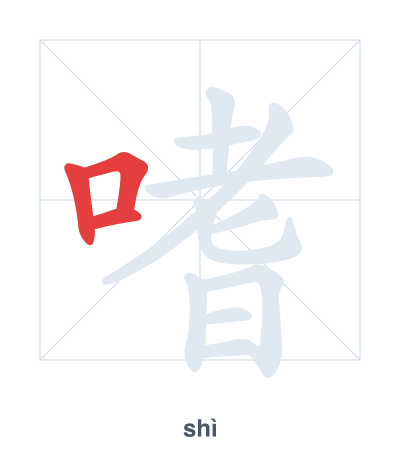
Open Hanzi Writer to see the animated stroke order and practice writing 嗜 with real-time feedback.
The character 嗜 (shì) is written with 13 strokes. Follow the standard Chinese stroke order: top to bottom, left to right, outside before inside. The radical 口 is one of its key components.
Practice the correct stroke order with the Hanzi Writer app to see animated stroke-by-stroke guidance with real-time feedback.
嗜 means To be fond of or have an addiction to..
As an HSK Level 7 character, 嗜 is an intermediate-level character.
The character 嗜 combines the mouth radical (口) with the phonetic component 耆 (shì), which originally meant 'old' or 'aged' but here provides the sound. The mouth radical indicates the action of tasting or craving, so the whole character conveys a strong fondness or addiction, often associated with indulging in food or drink.
💡 Memory Tip: Picture an old man (耆) with his mouth (口) wide open, desperately craving his favorite snack—he's addicted.
你的嗜好是什么?
nǐ de shì hào shì shén me
What are your hobbies?
生病时会很嗜睡。
shēng bìng shí huì hěn shì shuì
One becomes very lethargic when sick.
小孩子大多嗜甜。
xiǎo hái zi dà duō shì tián
Most children have a sweet tooth.
Open Hanzi Writer to see the animated stroke order and practice writing 嗜 with real-time feedback.
✨ Animated stroke order · Handwriting recognition · HSK-graded practice · Free to use
The character 嗜 combines the radical 口 (mouth) on the left with 耆 (qí) on the right. The radical 口 shows that the meaning involves the mouth, such as tasting or speaking. The right side 耆 gives the pronunciation and can suggest long-lasting habits, together forming the idea of being fond of or addicted to something.