睡 (shuì) means "To sleep." in Chinese. It has 13 strokes with the radical 目, and is HSK Level 1.
Rated 3.7/5 in difficulty (challenging).
Harder than 93% of HSK Level 1 characters.
Appears in 3+ common words including 睡觉 (shuì jiào), 午睡 (wǔ shuì), 睡着 (shuì zháo).
Due to its 13 strokes, Hanzi Writer's error detection shows 睡 requires focused practice — most learners need 10+ attempts for consistent accuracy.
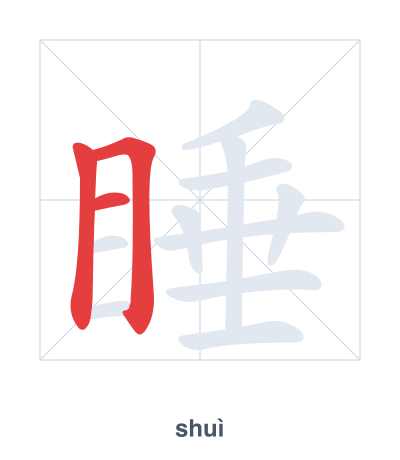
Open Hanzi Writer to see the animated stroke order and practice writing 睡 with real-time feedback.
The character 睡 (shuì) is written with 13 strokes. Follow the standard Chinese stroke order: top to bottom, left to right, outside before inside. The radical 目 is one of its key components.
Practice the correct stroke order with the Hanzi Writer app to see animated stroke-by-stroke guidance with real-time feedback.
睡 means To sleep..
As an HSK Level 1 character, 睡 is among the first characters beginners learn.
睡 combines the eye radical 目 (eye) with 垂 (to droop), depicting eyelids drooping down in sleep. The ancient meaning was 'to doze' as eyes hang heavy when falling asleep.
💡 Memory Tip: Imagine your eye (目) becoming so heavy it droops (垂) down like a curtain, signaling it’s time to sleep.
我想去睡觉。
wǒ xiǎng qù shuì jiào
I want to go to sleep.
他在午睡。
tā zài wǔ shuì
He is taking a nap.
弟弟睡着了。
dì di shuì zháo le
Little brother has fallen asleep.
Open Hanzi Writer to see the animated stroke order and practice writing 睡 with real-time feedback.
✨ Animated stroke order · Handwriting recognition · HSK-graded practice · Free to use
睡 is composed of the radical 目 (eye) on the left and the phonetic component 垂 (chuí, meaning 'to droop') on the right. Together, they suggest the action of closing or drooping one's eyes to sleep.