唫 (jìn) means "To hum / To close the mouth" in Chinese. It has 11 strokes with the radical 口.
Rated 4.2/5 in difficulty (advanced).
Appears in 3+ common words including 唫味 (jìn wèi), 唫口 (jìn kǒu), 唫唫 (jìn jìn).
Due to its 11 strokes, Hanzi Writer's error detection shows 唫 requires focused practice — most learners need 10+ attempts for consistent accuracy.
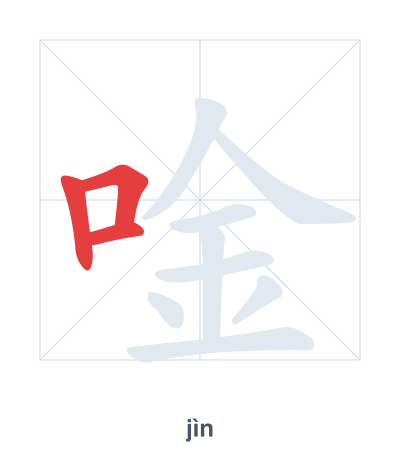
Open Hanzi Writer to see the animated stroke order and practice writing 唫 with real-time feedback.
The character 唫 (jìn) is written with 11 strokes. Follow the standard Chinese stroke order: top to bottom, left to right, outside before inside. The radical 口 is one of its key components.
Practice the correct stroke order with the Hanzi Writer app to see animated stroke-by-stroke guidance with real-time feedback.
唫 means To hum / To close the mouth.
唫 is a phono-semantic compound: the radical 口 (mouth) indicates an action involving the mouth, and the component 今 (jīn) provides the pronunciation. The meanings 'to hum' or 'to close the mouth' both relate to controlled mouth movements, possibly derived from the idea of keeping the mouth shut while producing sound.
💡 Memory Tip: Picture a mouth (口) that hums the sound 'jin' (今) while tightly closed, like a lock holding the lips together.
细细唫味生活。
xì xì jìn wèi shēng huó
Savor life carefully.
他唫口不言。
tā jìn kǒu bù yán
He kept his mouth shut and said nothing.
声音唫唫作响。
shēng yīn jìn jìn zuò xiǎng
The sound is humming or moaning.
Open Hanzi Writer to see the animated stroke order and practice writing 唫 with real-time feedback.
✨ Animated stroke order · Handwriting recognition · HSK-graded practice · Free to use
唫 is made of the radical 口 (mouth) on the left and the component 金 (jīn, gold/metal) on the right. The radical shows that the character is about mouth actions, while 金 provides the pronunciation and can suggest a humming sound like metal or a tightly closed mouth like a gold seal.