唪 (fěng) means "To recite / To chant" in Chinese. It has 11 strokes with the radical 口.
Rated 4.2/5 in difficulty (advanced).
Appears in 3+ common words including 唪诵 (fěng sòng), 唪经 (fěng jīng), 唪读 (fěng dú).
Due to its 11 strokes, Hanzi Writer's error detection shows 唪 requires focused practice — most learners need 10+ attempts for consistent accuracy.
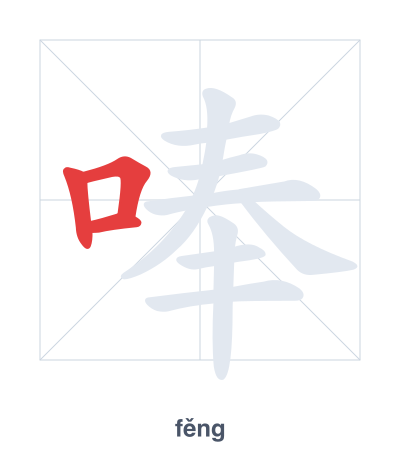
Open Hanzi Writer to see the animated stroke order and practice writing 唪 with real-time feedback.
The character 唪 (fěng) is written with 11 strokes. Follow the standard Chinese stroke order: top to bottom, left to right, outside before inside. The radical 口 is one of its key components.
Practice the correct stroke order with the Hanzi Writer app to see animated stroke-by-stroke guidance with real-time feedback.
唪 means To recite / To chant.
唪 is a phono-semantic compound combining the radical 口 (mouth) with 奉 (fèng, "to present/receive"). The mouth element directly ties to the action of reciting or chanting, while 奉 adds the phonetic component and hints at the idea of presenting words in a formal, ritualistic manner.
💡 Memory Tip: Picture a monk opening his mouth (口) to chant scriptures while holding an offering (奉) in his hands, solemnly reciting the sacred texts.
他在唪诵课文。
tā zài fěng sòng kè wén
He is chanting the text.
和尚在唪经。
hé shàng zài fěng jīng
The monk is chanting scriptures.
老师在唪读诗歌。
lǎo shī zài fěng dú shī gē
The teacher is chanting poetry.
Open Hanzi Writer to see the animated stroke order and practice writing 唪 with real-time feedback.
✨ Animated stroke order · Handwriting recognition · HSK-graded practice · Free to use
唪 is composed of the radical 口 (mouth) on the left and the phonetic component 奉 (fèng) on the right. The mouth radical suggests the action of speaking or reciting, while 奉 provides a hint to the pronunciation. Together, the character conveys the idea of using the mouth to chant or recite.