甜 (tián) means "sweet" in Chinese. It has 11 strokes with the radical 甘, and is HSK Level 3.
Rated 4.2/5 in difficulty (advanced).
Harder than 85% of HSK Level 3 characters.
Appears in 3+ common words including 甜点 (tián diǎn), 甜蜜 (tián mì), 甜头 (tián tóu).
Due to its 11 strokes, Hanzi Writer's error detection shows 甜 requires focused practice — most learners need 10+ attempts for consistent accuracy.
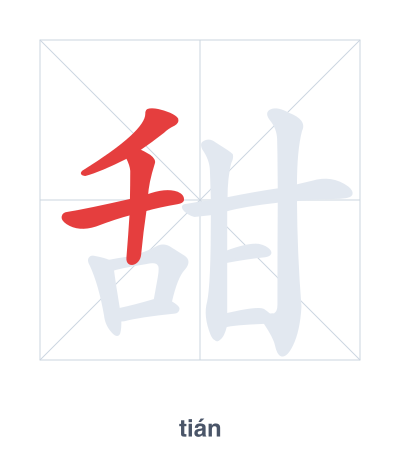
Open Hanzi Writer to see the animated stroke order and practice writing 甜 with real-time feedback.
The character 甜 (tián) is written with 11 strokes. Follow the standard Chinese stroke order: top to bottom, left to right, outside before inside. The radical 甘 is one of its key components.
Practice the correct stroke order with the Hanzi Writer app to see animated stroke-by-stroke guidance with real-time feedback.
甜 means sweet.
As an HSK Level 3 character, 甜 is an intermediate-level character.
甜 combines the tongue (舌) with the sweet radical (甘), literally depicting the tongue tasting sweetness. The left component 舌 represents the organ of taste, while 甘 conveys the flavor itself, forming a compound that visually shows sweetness being perceived.
💡 Memory Tip: Imagine your tongue (舌) licking a piece of sweet candy (甘) and exclaiming, 'Tián!'
我喜欢吃甜点。
wǒ xǐ huān chī tián diǎn
I like eating dessert.
他们的生活很甜蜜。
tā men de shēng huó hěn tián mì
Their life is very sweet.
他尝到了学习的甜头。
tā cháng dào le xué xí de tián tóu 。
He tasted the benefits of learning.
Open Hanzi Writer to see the animated stroke order and practice writing 甜 with real-time feedback.
✨ Animated stroke order · Handwriting recognition · HSK-graded practice · Free to use
甜 is formed from the left component 舌 (tongue) and the right component 甘 (sweet). Together, they suggest the idea of a tongue experiencing a sweet taste, which directly gives the meaning "sweet."