诗 (shī) means "Poem; poetry" in Chinese. It has 8 strokes with the radical 讠, and is HSK Level 4.
Rated 3.4/5 in difficulty (challenging).
Harder than 27% of HSK Level 4 characters.
Appears in 3+ common words including 诗人 (shī rén), 写诗 (xiě shī), 诗歌 (shī gē).
Due to its 8 strokes, Hanzi Writer's error detection shows 诗 requires focused practice — most learners need 10+ attempts for consistent accuracy.
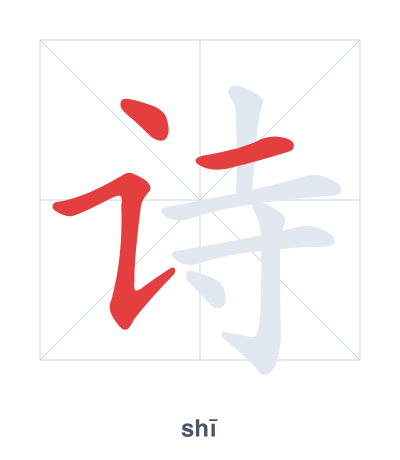
Open Hanzi Writer to see the animated stroke order and practice writing 诗 with real-time feedback.
The character 诗 (shī) is written with 8 strokes. Follow the standard Chinese stroke order: top to bottom, left to right, outside before inside. The radical 讠 is one of its key components.
Practice the correct stroke order with the Hanzi Writer app to see animated stroke-by-stroke guidance with real-time feedback.
诗 means Poem; poetry.
As an HSK Level 4 character, 诗 is an intermediate-level character.
诗 combines the radical 讠 (speech/words) with 寺 (temple), originally depicting the refined, rhythmic language used in ceremonial or sacred contexts—poetry as 'temple speech.'
💡 Memory Tip: Imagine a temple (寺) where every spoken word (讠) is turned into a beautiful poem.
他是一位著名的诗人。
tā shì yī wèi zhù míng de shī rén
He is a famous poet.
我喜欢在晚上写诗。
wǒ xǐ huān zài wǎn shàng xiě shī
I like writing poetry at night.
这里的诗歌非常美。
zhè lǐ de shī gē fēi cháng měi
The poetry here is very beautiful.
Open Hanzi Writer to see the animated stroke order and practice writing 诗 with real-time feedback.
✨ Animated stroke order · Handwriting recognition · HSK-graded practice · Free to use
诗 is a phonetic compound. The left radical 讠 means "speech" or "words," showing that poetry is related to language. The right part 寺 provides a pronunciation hint, though its original meaning of "temple" does not directly relate to poetry.