歌 (gē) means "song" in Chinese. It has 14 strokes with the radical 欠, and is HSK Level 1.
Rated 3.7/5 in difficulty (challenging).
Harder than 91% of HSK Level 1 characters.
Appears in 3+ common words including 唱歌 (chàng gē), 歌词 (gē cí), 歌手 (gē shǒu).
Due to its 14 strokes, Hanzi Writer's error detection shows 歌 requires focused practice — most learners need 10+ attempts for consistent accuracy.
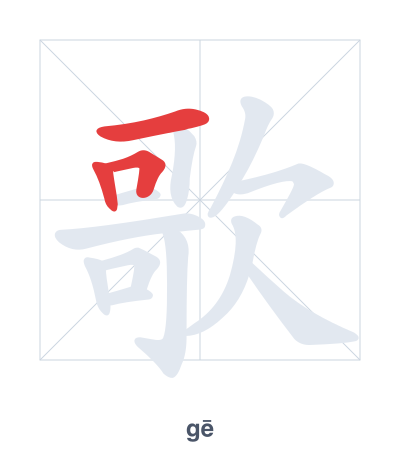
Open Hanzi Writer to see the animated stroke order and practice writing 歌 with real-time feedback.
The character 歌 (gē) is written with 14 strokes. Follow the standard Chinese stroke order: top to bottom, left to right, outside before inside. The radical 欠 is one of its key components.
Practice the correct stroke order with the Hanzi Writer app to see animated stroke-by-stroke guidance with real-time feedback.
歌 means song.
As an HSK Level 1 character, 歌 is among the first characters beginners learn.
歌 is a phono-semantic compound. The left part 哥 (gē) provides the sound and originally meant 'to sing', while the right part 欠 (qiàn) depicts a person opening their mouth to breathe or sing, indicating the vocal action. Together, they form the character for 'song' or 'to sing'.
💡 Memory Tip: Picture your elder brother (哥) yawning hugely (欠) and then breaking into a beautiful song.
我喜欢唱歌。
wǒ xǐ huān chàng gē
I like singing.
这首歌的歌词很美。
zhè shǒu gē de gē cí hěn měi
The lyrics of this song are very beautiful.
他是一名著名的歌手。
tā shì yī míng zhù míng de gē shǒu
He is a famous singer.
Open Hanzi Writer to see the animated stroke order and practice writing 歌 with real-time feedback.
✨ Animated stroke order · Handwriting recognition · HSK-graded practice · Free to use
The left part is 哥 (gē, elder brother) and the right part is 欠 (qiàn, to owe or open mouth). Together, 欠 suggests using your mouth, so the character means 'song' or 'to sing' – like an elder brother singing.