拾 (shè/shí) means "to pick up; ten (formal)" in Chinese. It has 9 strokes with the radical 扌, and is HSK Level 5.
Rated 4/5 in difficulty (challenging).
Harder than 50% of HSK Level 5 characters.
Appears in 3+ common words including 拾取 (shí qǔ), 收拾 (shōu shí), 拾级而上 (shè jí ér shàng).
Due to its 9 strokes, Hanzi Writer's error detection shows 拾 requires focused practice — most learners need 10+ attempts for consistent accuracy.
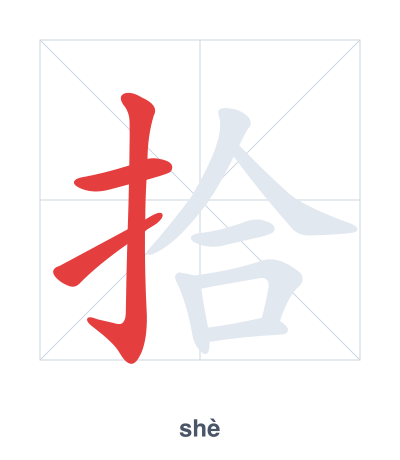
Open Hanzi Writer to see the animated stroke order and practice writing 拾 with real-time feedback.
The character 拾 (shè/shí) is written with 9 strokes. Follow the standard Chinese stroke order: top to bottom, left to right, outside before inside. The radical 扌 is one of its key components.
Practice the correct stroke order with the Hanzi Writer app to see animated stroke-by-stroke guidance with real-time feedback.
拾 means to pick up; ten (formal).
This is a polyphonic character with readings: shè, shí.
As an HSK Level 5 character, 拾 is an intermediate-level character.
拾 is a compound character: the radical 扌 (hand) indicates an action, while 合 (to join, fit together) adds phonetic hints. Its original meaning is 'to pick up' with the hand, and it is also used as the formal, fraud-resistant version of 'ten' (十) on documents.
💡 Memory Tip: Picture a hand (扌) picking up ten (十) fallen coins and fitting them together (合) into a neat stack.
环卫工人正在街道上拾取散落的废纸。
huán wèi gōng rén zhèng zài jiē dào shàng shí qǔ sàn luò de fèi zhǐ
Sanitation workers are picking up scattered waste paper on the street.
请在离开前把你的个人物品收拾干净。
qǐng zài lí kāi qián bǎ nǐ de gè rén wù pǐn shōu shí gān jìng
Please pack up your personal belongings before leaving.
游人们沿着石阶拾级而上,终于到达山顶。
yóu rén men yán zhe shí jiē shè jí ér shàng zhōng yú dào dá shān dǐng
Tourists climbed the stone steps one by one and finally reached the summit.
Open Hanzi Writer to see the animated stroke order and practice writing 拾 with real-time feedback.
✨ Animated stroke order · Handwriting recognition · HSK-graded practice · Free to use
The left side is the radical 扌, meaning "hand," which shows the action involves the hand. The right side is 合 (hé), meaning "to combine" or "together," so 拾 visually suggests using your hand to bring things together, which relates to "picking up."