取 (qǔ) means "to take; to get; to fetch" in Chinese. It has 8 strokes with the radical 又, and is HSK Level 2.
Rated 2.9/5 in difficulty (moderate).
Harder than 35% of HSK Level 2 characters.
Appears in 3+ common words including 取钱 (qǔ qián), 取得 (qǔ dé), 取消 (qǔ xiāo).
Hanzi Writer's stroke validation shows learners typically need 5-8 attempts to write 取 with correct proportion and order.
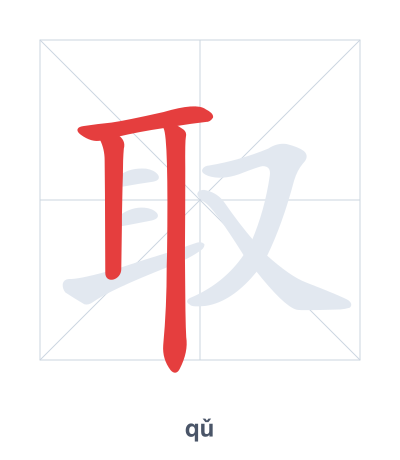
Open Hanzi Writer to see the animated stroke order and practice writing 取 with real-time feedback.
The character 取 (qǔ) is written with 8 strokes. Follow the standard Chinese stroke order: top to bottom, left to right, outside before inside. The radical 又 is one of its key components.
Practice the correct stroke order with the Hanzi Writer app to see animated stroke-by-stroke guidance with real-time feedback.
取 means to take; to get; to fetch.
As an HSK Level 2 character, 取 is among the first characters beginners learn.
取 combines 耳 (ear) and 又 (hand), depicting a hand taking an ear—a reference to ancient battlefield practice where warriors cut off enemies' ears as proof of victory.
💡 Memory Tip: Picture a hand (又) reaching out to grab someone's ear (耳) to 'take' it.
我去银行取钱。
wǒ qù yín háng qǔ qián
I'm going to the bank to withdraw money.
他取得了成功。
tā qǔ dé le chéng gōng
He achieved success.
比赛被取消了。
bǐ sài bèi qǔ xiāo le
The match was canceled.
Open Hanzi Writer to see the animated stroke order and practice writing 取 with real-time feedback.
✨ Animated stroke order · Handwriting recognition · HSK-graded practice · Free to use
取 is made of 耳 (ear) on the left and 又 (hand) on the right. The character originally showed a hand taking an ear, which was a way to count kills in ancient battles, so the whole character means 'to take' or 'to get'.