奖 (jiǎng) means "prize; award; reward" in Chinese. It has 9 strokes with the radical 大, and is HSK Level 4.
Rated 4/5 in difficulty (challenging).
Harder than 57% of HSK Level 4 characters.
Appears in 3+ common words including 奖学金 (jiǎng xué jīn), 奖励 (jiǎng lì), 奖金 (jiǎng jīn).
Due to its 9 strokes, Hanzi Writer's error detection shows 奖 requires focused practice — most learners need 10+ attempts for consistent accuracy.
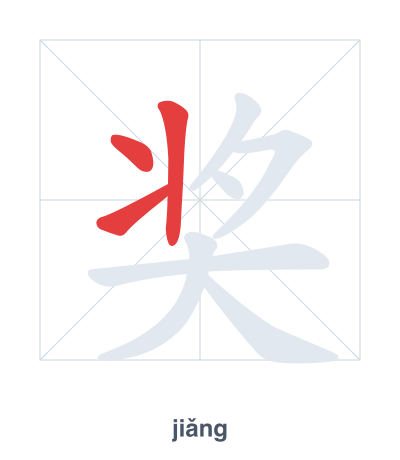
Open Hanzi Writer to see the animated stroke order and practice writing 奖 with real-time feedback.
The character 奖 (jiǎng) is written with 9 strokes. Follow the standard Chinese stroke order: top to bottom, left to right, outside before inside. The radical 大 is one of its key components.
Practice the correct stroke order with the Hanzi Writer app to see animated stroke-by-stroke guidance with real-time feedback.
奖 means prize; award; reward.
As an HSK Level 4 character, 奖 is an intermediate-level character.
奖 originally combined 將 (sound, meaning 'general' or 'to lead') and 犬 (dog) to depict a reward given to a hunting dog. The simplified form replaced 犬 with 大 (big), but the core idea of a prize or award remains.
💡 Memory Tip: Picture a big (大) prize being handed to a general (the top part resembling 将) for leading his troops to victory.
我拿到了奖学金。
wǒ ná dào le jiǎng xué jīn
I got a scholarship.
老师奖励了我。
lǎo shī jiǎng lì le wǒ
The teacher rewarded me.
公司发了奖金。
gōng sī fā le jiǎng jīn
The company issued bonuses.
Open Hanzi Writer to see the animated stroke order and practice writing 奖 with real-time feedback.
✨ Animated stroke order · Handwriting recognition · HSK-graded practice · Free to use
奖 consists of the radical 大 (big) on top and a lower part made of 丬 (wood piece) and 夕 (evening). The 大 suggests something important or grand, while the lower part visually resembles a reward token or certificate. Together they convey the idea of a big prize or award.