惹 (rě) means "to provoke" in Chinese. It has 12 strokes with the radical 心, and is HSK Level 7.
Rated 4.2/5 in difficulty (advanced).
Harder than 56% of HSK Level 7 characters.
Appears in 3+ common words including 惹麻烦 (rě má fán), 惹人爱 (rě rén ài), 惹生气 (rě shēng qì).
Due to its 12 strokes, Hanzi Writer's error detection shows 惹 requires focused practice — most learners need 10+ attempts for consistent accuracy.
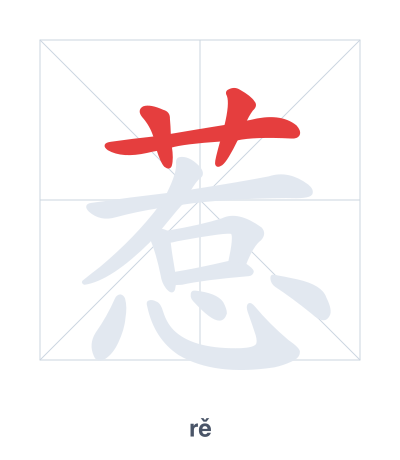
Open Hanzi Writer to see the animated stroke order and practice writing 惹 with real-time feedback.
The character 惹 (rě) is written with 12 strokes. Follow the standard Chinese stroke order: top to bottom, left to right, outside before inside. The radical 心 is one of its key components.
Practice the correct stroke order with the Hanzi Writer app to see animated stroke-by-stroke guidance with real-time feedback.
惹 means to provoke.
As an HSK Level 7 character, 惹 is an intermediate-level character.
惹 combines the phonetic component 若 (ruò, meaning 'like' or 'resemble') with the radical 心 (heart), indicating that provoking stirs the heart's emotional response. The top part 若 itself consists of 艹 (grass) over 右 (right hand), suggesting an action of touching or disturbing. Together, the character visually implies an action that 'touches the heart' and causes annoyance or agitation.
💡 Memory Tip: Picture a right hand (右) holding a plant (艹) poking a heart (心) — that provokes it.
别给我惹麻烦。
bié gěi wǒ rě má fán
Don't cause me any trouble.
那个孩子很惹人爱。
nà ge hái zi hěn rě rén ài
That child is very lovable.
你这种开玩笑的方式很容易把邻居惹生气。
nǐ zhè zhǒng kāi wán xiào de fāng shì hěn róng yì bǎ lín jū rě shēng qì 。
This way of joking is likely to make the neighbors angry.
Open Hanzi Writer to see the animated stroke order and practice writing 惹 with real-time feedback.
✨ Animated stroke order · Handwriting recognition · HSK-graded practice · Free to use
惹 is made of two parts: 若 (ruò, meaning "like" or "if") on top and 心 (heart) at the bottom. Together they suggest that provoking someone stirs or touches their heart. The heart radical emphasizes the emotional nature of this action.