却 (què) means "but; yet; however; to retreat" in Chinese. It has 7 strokes with the radical 卩, and is HSK Level 4.
Rated 3.2/5 in difficulty (challenging).
Harder than 18% of HSK Level 4 characters.
Appears in 2+ common words including 退却 (tuì què), 忘却 (wàng què).
Due to its 7 strokes, Hanzi Writer's error detection shows 却 requires focused practice — most learners need 10+ attempts for consistent accuracy.
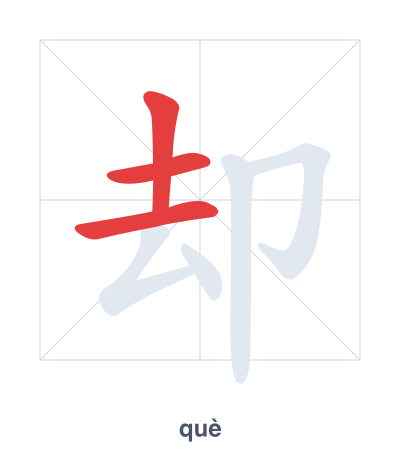
Open Hanzi Writer to see the animated stroke order and practice writing 却 with real-time feedback.
The character 却 (què) is written with 7 strokes. Follow the standard Chinese stroke order: top to bottom, left to right, outside before inside. The radical 卩 is one of its key components.
Practice the correct stroke order with the Hanzi Writer app to see animated stroke-by-stroke guidance with real-time feedback.
却 means but; yet; however; to retreat.
As an HSK Level 4 character, 却 is an intermediate-level character.
却 combines 去 (to leave) and 卩 (a kneeling person), originally meaning to step back or retreat, as in a kneeling person withdrawing. Over time, it gained the adversative meanings 'but' and 'yet' by implying a turning away from expectations. The visual shows someone going away (去) while in a kneeling posture (卩), reinforcing the idea of retreating or reversing direction.
💡 Memory Tip: Picture a kneeling person (卩) who suddenly stands up and runs away (去)—that unexpected retreat adds a 'but' or 'however' twist to the story.
面对困难,我们不能退却。
miàn duì kùn nán , wǒ men bù néng tuì què 。
Facing difficulties, we cannot retreat.
不要忘却过去。
bú yào wàng què guò qù
Don't forget the past.
敌人开始退却。
dí rén kāi shǐ tuì què
The enemy began to retreat.
Open Hanzi Writer to see the animated stroke order and practice writing 却 with real-time feedback.
✨ Animated stroke order · Handwriting recognition · HSK-graded practice · Free to use
却 is made of 去 (to go) on the left and 卩 (a kneeling person or seal) on the right. Originally it meant "to retreat" — a person kneeling and going away. This idea of stepping back later extended to the contrastive meanings "but" and "yet."