印 (yìn) means "to print; seal; stamp; mark" in Chinese. It has 5 strokes with the radical 卩, and is HSK Level 2.
Rated 2.2/5 in difficulty (moderate).
Harder than 11% of HSK Level 2 characters.
Appears in 3+ common words including 打印 (dǎ yìn), 印象 (yìn xiàng), 复印 (fù yìn).
Hanzi Writer's stroke validation shows learners typically need 5-8 attempts to write 印 with correct proportion and order.
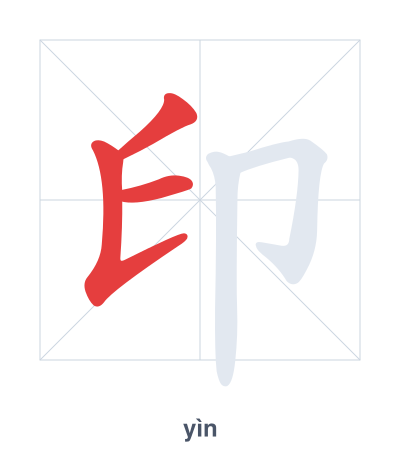
Open Hanzi Writer to see the animated stroke order and practice writing 印 with real-time feedback.
The character 印 (yìn) is written with 5 strokes. Follow the standard Chinese stroke order: top to bottom, left to right, outside before inside. The radical 卩 is one of its key components.
Practice the correct stroke order with the Hanzi Writer app to see animated stroke-by-stroke guidance with real-time feedback.
印 means to print; seal; stamp; mark.
As an HSK Level 2 character, 印 is among the first characters beginners learn.
Originally a pictograph showing a hand (爫) pressing down on a kneeling person (卩), symbolizing the act of making an impression or stamp. This later evolved into the modern character meaning 'to print' or 'seal'.
💡 Memory Tip: Imagine a hand (left side) pressing a rubber stamp shaped like a kneeling person (right side) onto paper, leaving a clear 'print' mark.
我要打印这份文件。
wǒ yào dǎ yìn zhè fèn wén jiàn
I want to print this document.
他的印象很深。
tā de yìn xiàng hěn shēn
He has a deep impression.
请复印这张纸。
qǐng fù yìn zhè zhāng zhǐ
Please photocopy this paper.
Open Hanzi Writer to see the animated stroke order and practice writing 印 with real-time feedback.
✨ Animated stroke order · Handwriting recognition · HSK-graded practice · Free to use
印 is made of two parts: the left side looks like a hand (爪), and the right side is 卩, which represents a kneeling person. Together, they show a hand pressing down on a person, which relates to the original meaning of 'impressing' or 'stamping' a seal.