卸 (xiè) means "to unload or remove" in Chinese. It has 9 strokes with the radical 卩, and is HSK Level 7.
Rated 3.7/5 in difficulty (challenging).
Harder than 23% of HSK Level 7 characters.
Appears in 3+ common words including 卸货 (xiè huò), 卸妆 (xiè zhuāng), 拆卸 (chāi xiè).
Due to its 9 strokes, Hanzi Writer's error detection shows 卸 requires focused practice — most learners need 10+ attempts for consistent accuracy.
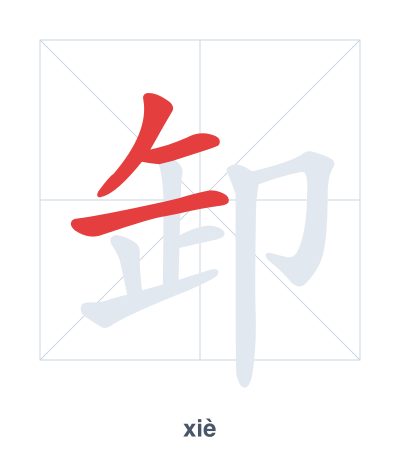
Open Hanzi Writer to see the animated stroke order and practice writing 卸 with real-time feedback.
The character 卸 (xiè) is written with 9 strokes. Follow the standard Chinese stroke order: top to bottom, left to right, outside before inside. The radical 卩 is one of its key components.
Practice the correct stroke order with the Hanzi Writer app to see animated stroke-by-stroke guidance with real-time feedback.
卸 means to unload or remove.
As an HSK Level 7 character, 卸 is an intermediate-level character.
卸 combines a kneeling person (卩) with 午 (originally a horse or harness) and 止 (stop), depicting the action of stopping a horse to remove its harness, leading to the meanings 'to unload' or 'remove'.
💡 Memory Tip: Picture a kneeling servant (卩) halting (止) the horse (午) to unload its heavy bags.
工人在卸货。
gōng rén zài xiè huò
The worker is unloading goods.
她正在卸妆。
tā zhèng zài xiè zhuāng
She is removing her makeup.
机器需要拆卸。
jī qì xū yào chāi xiè
The machine needs to be disassembled.
Open Hanzi Writer to see the animated stroke order and practice writing 卸 with real-time feedback.
✨ Animated stroke order · Handwriting recognition · HSK-graded practice · Free to use
卸 consists of three parts: the left radical 卩 (seal or knotted cord), the upper right 止 (stop), and the lower right 午 (noon). Together they suggest stopping a sealed item to remove or untie it, like unloading cargo.