卵 (luǎn) means "egg; ovum; spawn" in Chinese. It has 7 strokes with the radical 卩, and is HSK Level 7.
Rated 3.2/5 in difficulty (challenging).
Harder than 9% of HSK Level 7 characters.
Appears in 3+ common words including 卵生 (luǎn shēng), 鱼卵 (yú luǎn), 卵子 (luǎn zi).
Due to its 7 strokes, Hanzi Writer's error detection shows 卵 requires focused practice — most learners need 10+ attempts for consistent accuracy.
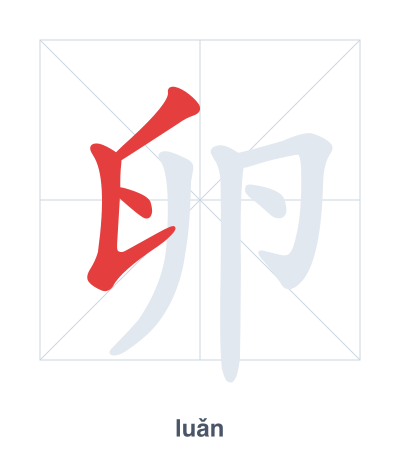
Open Hanzi Writer to see the animated stroke order and practice writing 卵 with real-time feedback.
The character 卵 (luǎn) is written with 7 strokes. Follow the standard Chinese stroke order: top to bottom, left to right, outside before inside. The radical 卩 is one of its key components.
Practice the correct stroke order with the Hanzi Writer app to see animated stroke-by-stroke guidance with real-time feedback.
卵 means egg; ovum; spawn.
As an HSK Level 7 character, 卵 is an intermediate-level character.
The character 卵 is a pictograph. Its ancient oracle bone form depicted two round objects with internal dots, representing fish eggs or spawn. Over time, the shape simplified into two symmetrical halves (each resembling the radical 卩) side by side, still suggesting two ovals or eggs.
💡 Memory Tip: Picture two mirrored eggs sitting side by side, each with a tiny yolk dot inside, forming the left and right halves of 卵.
鸟类是卵生动物。
niǎo lèi shì luǎn shēng dòng wù
Birds are oviparous (egg-laying) animals.
鱼卵在水中。
yú luǎn zài shuǐ zhōng
The fish eggs are in the water.
这是卵子细胞。
zhè shì luǎn zi xì bāo
This is an egg cell.
Open Hanzi Writer to see the animated stroke order and practice writing 卵 with real-time feedback.
✨ Animated stroke order · Handwriting recognition · HSK-graded practice · Free to use
The character 卵 consists of two small 'snap' components (卩) placed side by side, resembling two eggs or cells. This structure visually represents the concept of an egg or ovum, as the two parts mirror the shape of a fertilized egg or paired reproductive cells.