哈 (hā) means "ha; to breathe out" in Chinese. It has 9 strokes with the radical 口, and is HSK Level 3.
Rated 4/5 in difficulty (challenging).
Harder than 60% of HSK Level 3 characters.
Appears in 3+ common words including 哈哈 (hā hā), 哈欠 (hā qiàn), 哈气 (hā qì).
Due to its 9 strokes, Hanzi Writer's error detection shows 哈 requires focused practice — most learners need 10+ attempts for consistent accuracy.
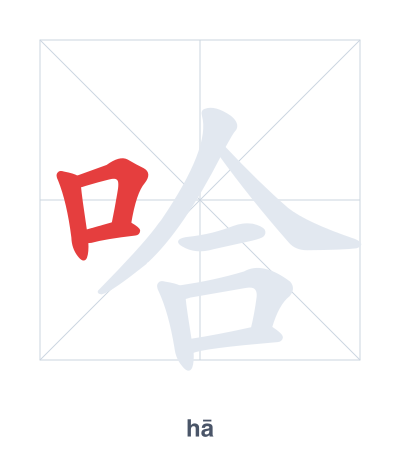
Open Hanzi Writer to see the animated stroke order and practice writing 哈 with real-time feedback.
The character 哈 (hā) is written with 9 strokes. Follow the standard Chinese stroke order: top to bottom, left to right, outside before inside. The radical 口 is one of its key components.
Practice the correct stroke order with the Hanzi Writer app to see animated stroke-by-stroke guidance with real-time feedback.
哈 means ha; to breathe out.
As an HSK Level 3 character, 哈 is an intermediate-level character.
哈 is a compound character with the radical 口 (mouth) indicating breath or sound, and the phonetic component 合 (hé) hinting at the pronunciation. It depicts the action of exhaling or the sound of laughter, like saying 'ha' from the mouth.
💡 Memory Tip: Picture a mouth (口) opening wide to exhale a joyful 'Ha!', while the right part 合 looks like a person doubling over with laughter.
他哈哈大笑。
tā hā hā dà xiào
He laughed out loud.
我打了一个哈欠。
wǒ dǎ le yí gè hā qiàn
I yawned.
他对着手哈气。
tā duì zhuó shǒu hā qì
He breathed on his hands.
Open Hanzi Writer to see the animated stroke order and practice writing 哈 with real-time feedback.
✨ Animated stroke order · Handwriting recognition · HSK-graded practice · Free to use
哈 is made of the radical 口 (mouth) on the left and the phonetic component 合 on the right. The mouth radical indicates actions involving the mouth, like laughing or breathing out. The right part 合 gives a clue to the pronunciation "ha" and also suggests the idea of combining or closing, as in the sound of a laugh.