丐 (gài) means "beggar; to beg" in Chinese. It has 4 strokes with the radical 一, and is HSK Level 7.
Rated 2.4/5 in difficulty (moderate).
Harder than 1% of HSK Level 7 characters.
Appears in 3+ common words including 乞丐 (qǐ gài), 丐帮 (gài bāng), 乞丐服 (qǐ gài fú).
Hanzi Writer's stroke validation shows learners typically need 5-8 attempts to write 丐 with correct proportion and order.
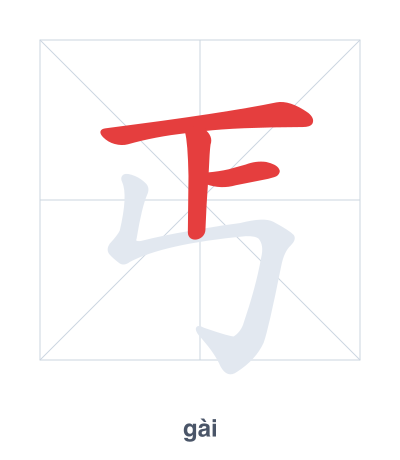
Open Hanzi Writer to see the animated stroke order and practice writing 丐 with real-time feedback.
The character 丐 (gài) is written with 4 strokes. Follow the standard Chinese stroke order: top to bottom, left to right, outside before inside. The radical 一 is one of its key components.
Practice the correct stroke order with the Hanzi Writer app to see animated stroke-by-stroke guidance with real-time feedback.
丐 means beggar; to beg.
As an HSK Level 7 character, 丐 is an intermediate-level character.
丐 originally depicted a person with an outstretched hand and a bowl (the top horizontal line) asking for food, evolving from the ancient form 匄 which combined a covering (勹) and a person (亻). The modern shape simplifies this into a pictograph of a beggar with a bowl and a walking stick.
💡 Memory Tip: Picture a beggar with a bowl (top horizontal line), a walking stick (curved vertical), and a single drop of soup (the dot) inside the bowl.
路边坐着一个乞丐。
lù biān zuò zhe yí gè qǐ gài
A beggar is sitting by the roadside.
丐帮出现在武侠小说中。
gài bāng chū xiàn zài wǔ xiá xiǎo shuō zhōng
The Beggars' Gang appears in martial arts novels.
他穿着一件乞丐服。
tā chuān zhe yī jiàn qǐ gài fú
He is wearing a beggar's outfit.
Open Hanzi Writer to see the animated stroke order and practice writing 丐 with real-time feedback.
✨ Animated stroke order · Handwriting recognition · HSK-graded practice · Free to use
The character 丐 consists of a top horizontal line (一) and a lower part that resembles a person bending forward with an outstretched arm. This shape visually suggests a beggar bowing to ask for money or food, which matches the meaning ‘beggar’ or ‘to beg.’