就 (jiù) means "just; then; at once; right away" in Chinese. It has 12 strokes with the radical 尢, and is HSK Level 1.
Rated 3.4/5 in difficulty (challenging).
Harder than 73% of HSK Level 1 characters.
Appears in 3+ common words including 就是 (jiù shì), 就要 (jiù yào), 就在 (jiù zài).
Due to its 12 strokes, Hanzi Writer's error detection shows 就 requires focused practice — most learners need 10+ attempts for consistent accuracy.
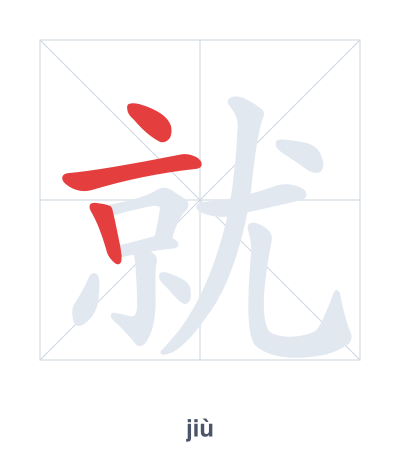
Open Hanzi Writer to see the animated stroke order and practice writing 就 with real-time feedback.
The character 就 (jiù) is written with 12 strokes. Follow the standard Chinese stroke order: top to bottom, left to right, outside before inside. The radical 尢 is one of its key components.
Practice the correct stroke order with the Hanzi Writer app to see animated stroke-by-stroke guidance with real-time feedback.
就 means just; then; at once; right away.
As an HSK Level 1 character, 就 is among the first characters beginners learn.
就 combines 京 (capital city) and 尢 (a person with a limp), originally depicting a person limping toward the capital to arrive or approach. This sense of 'reaching a destination' evolved into the meanings 'just then' or 'at once', indicating immediate action.
💡 Memory Tip: Picture a lame person (尢) sprinting to the capital (京) and arriving 'just in time' (就).
他就是我的老师。
tā jiù shì wǒ de lǎo shī
He is my teacher.
火车就要开了。
huǒ chē jiù yào kāi le
The train is about to leave.
书就在桌子上。
shū jiù zài zhuō zi shàng
The book is right on the table.
Open Hanzi Writer to see the animated stroke order and practice writing 就 with real-time feedback.
✨ Animated stroke order · Handwriting recognition · HSK-graded practice · Free to use
就 is made of two parts: the left side is 京 (meaning capital city) and the right side is 尤 (meaning especially). Together, they form the character that often means 'just' or 'then'. The radical is 尢, which is a variation of the right component.