捧 (pěng) means "Hold with both hands / Praise" in Chinese. It has 11 strokes with the radical 扌, and is HSK Level 7.
Rated 4.2/5 in difficulty (advanced).
Harder than 58% of HSK Level 7 characters.
Appears in 3+ common words including 捧着 (pěng zhe), 吹捧 (chuī pěng), 捧场 (pěng chǎng).
Due to its 11 strokes, Hanzi Writer's error detection shows 捧 requires focused practice — most learners need 10+ attempts for consistent accuracy.
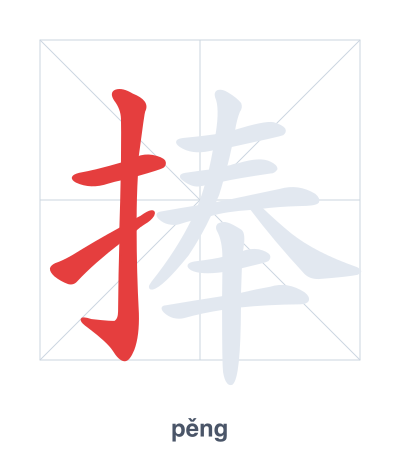
Open Hanzi Writer to see the animated stroke order and practice writing 捧 with real-time feedback.
The character 捧 (pěng) is written with 11 strokes. Follow the standard Chinese stroke order: top to bottom, left to right, outside before inside. The radical 扌 is one of its key components.
Practice the correct stroke order with the Hanzi Writer app to see animated stroke-by-stroke guidance with real-time feedback.
捧 means Hold with both hands / Praise.
As an HSK Level 7 character, 捧 is an intermediate-level character.
捧 combines the hand radical 扌 with 奉 (fèng 'to offer respectfully'). 奉 itself depicts two hands holding an offering, so together 捧 literally shows hands presenting something—hence 'hold with both hands' and metaphorically 'praise' as in offering honor.
💡 Memory Tip: Picture both hands (扌) cupping a golden trophy (奉) as you raise it to praise the winner.
他手里捧着一本书。
tā shǒu lǐ pěng zhe yī běn shū
He is holding a book in both hands.
别总是吹捧他。
bié zǒng shì chuī pěng tā
Don't always flatter him.
谢谢大家来捧场。
xiè xiè dà jiā lái pěng chǎng
Thank you all for coming to support me.
Open Hanzi Writer to see the animated stroke order and practice writing 捧 with real-time feedback.
✨ Animated stroke order · Handwriting recognition · HSK-graded practice · Free to use
捧 has two parts: the radical 扌 (hand) on the left, and 奉 (fèng, to offer) on the right. The hand radical indicates that the action involves the hands, while 奉 suggests the idea of offering something respectfully, so together they mean "to hold with both hands" or "to praise."