吹 (chuī) means "to blow" in Chinese. It has 7 strokes with the radical 口, and is HSK Level 2.
Rated 2.9/5 in difficulty (moderate).
Harder than 36% of HSK Level 2 characters.
Appears in 3+ common words including 吹风 (chuī fēng), 吹牛 (chuī niú), 吹笛子 (chuī dí zi).
Hanzi Writer's stroke validation shows learners typically need 5-8 attempts to write 吹 with correct proportion and order.
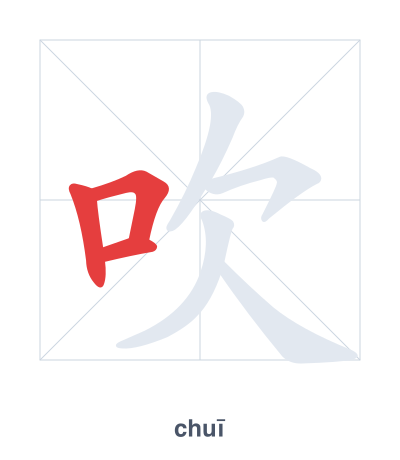
Open Hanzi Writer to see the animated stroke order and practice writing 吹 with real-time feedback.
The character 吹 (chuī) is written with 7 strokes. Follow the standard Chinese stroke order: top to bottom, left to right, outside before inside. The radical 口 is one of its key components.
Practice the correct stroke order with the Hanzi Writer app to see animated stroke-by-stroke guidance with real-time feedback.
吹 means to blow.
As an HSK Level 2 character, 吹 is among the first characters beginners learn.
吹 combines the mouth radical (口) with 欠, which originally depicted a person with an open mouth exhaling. Together they represent blowing air forcefully from the mouth, as in blowing out a candle or blowing wind.
💡 Memory Tip: Imagine a mouth (口) blowing out a row of candles, each puff forming a '欠' shape as the air flows out.
我想去海边吹风。
wǒ xiǎng qù hǎi biān chuī fēng
I want to go to the seaside to enjoy the breeze.
他总是在吹牛。
tā zǒng shì zài chuī niú
He is always bragging.
妹妹在吹笛子。
mèi mèi zài chuī dí zi
My younger sister is playing the flute.
Open Hanzi Writer to see the animated stroke order and practice writing 吹 with real-time feedback.
✨ Animated stroke order · Handwriting recognition · HSK-graded practice · Free to use
吹 combines the radical 口 (mouth, left side) with 欠 (to owe or lack, right side). The mouth component directly connects to the action of blowing air from the mouth, while 欠 hints at exhaling or letting out breath.