浓 (nóng) means "thick; dense; strong (flavor/smell)" in Chinese. It has 9 strokes with the radical 氵, and is HSK Level 4.
Rated 4/5 in difficulty (challenging).
Harder than 61% of HSK Level 4 characters.
Appears in 3+ common words including 浓茶 (nóng chá), 浓厚 (nóng hòu), 浓烟 (nóng yān).
Due to its 9 strokes, Hanzi Writer's error detection shows 浓 requires focused practice — most learners need 10+ attempts for consistent accuracy.
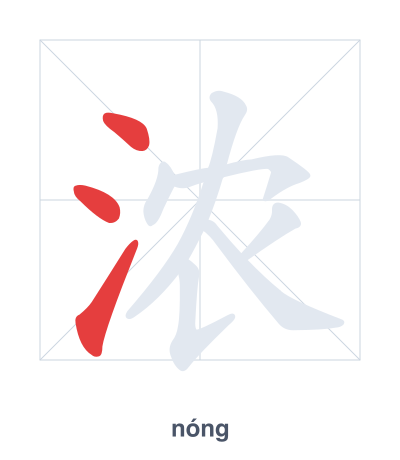
Open Hanzi Writer to see the animated stroke order and practice writing 浓 with real-time feedback.
The character 浓 (nóng) is written with 9 strokes. Follow the standard Chinese stroke order: top to bottom, left to right, outside before inside. The radical 氵 is one of its key components.
Practice the correct stroke order with the Hanzi Writer app to see animated stroke-by-stroke guidance with real-time feedback.
浓 means thick; dense; strong (flavor/smell).
As an HSK Level 4 character, 浓 is an intermediate-level character.
This character combines the water radical (氵) with the phonetic component 农 (nóng, meaning farming). The water radical indicates the meaning relates to liquids, evoking thick, dense mixtures like muddy water from agricultural fields.
💡 Memory Tip: Picture water (氵) mixing with a farmer's (农) thick, rich soil to create a dense, strong-smelling mud.
医生不让我喝浓茶。
yī shēng bù ràng wǒ hē nóng chá
The doctor told me not to drink strong tea.
这里的文化气息浓厚。
zhè lǐ de wén huà qì xī nóng hòu
The cultural atmosphere here is strong.
森林里有浓烟。
sēn lín lǐ yǒu nóng yān
There is thick smoke in the forest.
Open Hanzi Writer to see the animated stroke order and practice writing 浓 with real-time feedback.
✨ Animated stroke order · Handwriting recognition · HSK-graded practice · Free to use
The left side is the water radical 氵, indicating something related to liquid. The right side 农 (nóng) provides pronunciation and suggests the idea of "concentrated" like a farmer's strong labor. Together, they form the meaning of thick or dense, like strong tea or thick smoke.